

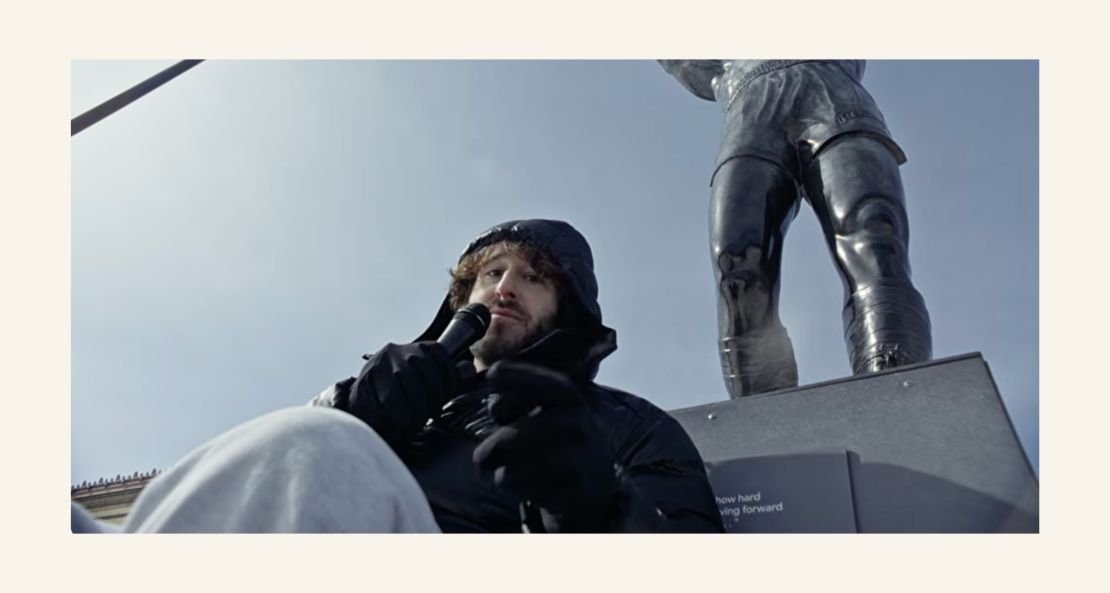
Lil Dicky returns with Philly Freestyle (released February 13, 2026), his first substantial rap offering in years, and it sounds like someone arguing his case before the trial begins.
After three seasons of Dave and a conspicuous absence from music, he’s back on the Philadelphia Museum of Art steps – Rocky’s symbolic ground for underdogs – making sure you know he never really left.
The visual concept matters. Director Phillip Lopez opens wide on Lil Dicky against the museum’s facade in winter grey, then slowly pushes in until the institutional grandeur becomes a close-up confession. Aspiration meets justification. The camera doesn’t blink and neither does he.
The production strips everything bare – quiet guitar, sparse piano, no drops. “Ain’t no drop offs, I got my rocks off,” he announces, turning the absence of a beat switch into proof of intent.
When you’ve been gone this long, when Reddit threads ask if you’re coming back just to grab quick money, you don’t hide behind production. You make them listen to every word.
The flow is effortless. He moves through the verse with the same poised cadence that made Professional Rapper work, that spoken-word clarity where every syllable lands exactly where he wants it.
Technically, he’s sharp – the Wembanyama/Spurs double entendre, the Jeff Hornacek pull, the “99 on the Rams” threading NFL history with rap ranking. These are the kind of layered references that proved he belonged here in the first place.
But the lyrics give him away. “I can’t be a case of ‘Well, I guess we’ll never know'” arrives in the first thirty seconds, naming the doubt before anyone else can. “Let me tell you, the way I’ve been working over here silently I don’t give a fuck” – except he clearly does, or he wouldn’t be explaining it on the Rocky steps in February.
The Frank Ocean birthday story encapsulates the whole freestyle. He positions himself in rarefied creative company, then immediately undercuts it: “I never met him, though, the party was wild / Some people saw him.”
It’s flex and deflation in the same breath, celebrity proximity without confirmation, the kind of self-aware humor that makes him compelling even when he’s defensive.
Because defensive is what this is. “I didn’t ever stop / This for those who thought they could come and take my spot” sounds like someone who stopped and now needs to reclaim what he walked away from. The entire freestyle anticipates criticism rather than ignoring it.
The outro makes this explicit. “Yeah, some things are never over / Well, this is over. But you’re still here, huh? / I love you.” Is that confidence or acknowledgment that goodwill runs out?
Philly Freestyle is technically accomplished and honest about the awkward position of returning when nobody asked.
Whether anyone cares what comes next depends entirely on whether Lil Dicky actually follows through this time – or if these Rocky steps are just another symbolic climb before he disappears again.
You might also like:
- Drake’s “Fighting Irish Freestyle”: Unraveling 2025’s Most Complex Diss Track
- Jack Harlow’s “Tranquility”: A Deep Dive into Lyrics, Meaning, and Artistic Growth
- J. Cole’s cLOUDs Lyrics Meaning and Review: A Reflection on AI, Greed, and the Future of Hip-Hop
- J. Cole’s ‘Port Antonio’: More Than Just a Rap Feud
- Drake’s Gimme A Hug Lyrics Meaning and Review: A Breakdown of His Latest Statement Track
- Jack Harlow Set You Free Lyrics Meaning and Review: His Most Honest Song Yet?


