
The Great Music Video Debate
Let’s settle this once and for all. Music videos might be the most expensive lottery ticket in the music industry, and artists are scratching them off with the wrong coin. The debate rages on whether music videos are dead, but the answer is far more complicated than a simple yes or no.
Labels have been spending less and less on music videos over the past decade. This has led to a flood of mediocre productions that fail to capture attention the way they once did.
When social media took over, traditional music videos slipped to the back in terms of efficiency in reaching new audiences.
However, performance will always be something audiences want from their artists. We get excited about seeing Beyoncé in concert precisely because she sets a precedent in her music videos.
The landscape has evolved. Content is king, and everybody’s attention is glued to their phones. Music video directors are still very much needed, but their jobs have changed dramatically. They must take creative storytelling skills from traditional music videos and reapply them to vertical video content.
The Three Tiers of Visual Content
There are currently three tiers of music promotion visuals that artists should understand:
Tier 1: Low-Maintenance Vertical Content
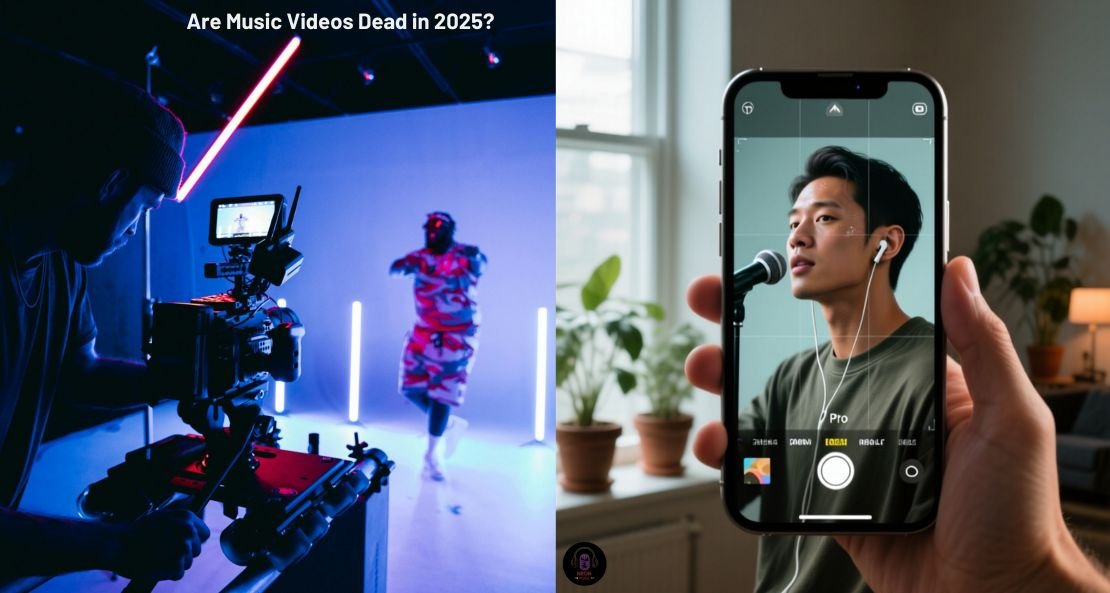
This is the bottom tier of really low-maintenance content. An artist can literally prop up their camera, perform their verse to camera, add lyrics on screen, and rack up thousands of views from new audiences. These simple vertical performances work brilliantly for getting new fans in the door.
As this type of content becomes more saturated, artists will need to get more creative, which is where visual creative directors still play a role.
Tier 2: TikTokified Music Videos
This tier represents the newest form of music video we’ve seen in the last decade. Think of them as TikTokified or Instagramified music videos. All the creativity and performance level of traditional music videos, but curated and compacted into vertical format.
These rely heavily on transitions, visual effects, and camera tricks that audiences have developed an appetite for on social media.
This content tier keeps audiences obsessed and turns casual listeners into mega-fans. According to recent data, short-form videos like TikTok and Instagram Reels now offer the highest return on investment compared to other marketing formats.
Users watched an average of 17 hours of online video content per week in 2023, with the average online video view time hovering around 10 seconds on platforms like Facebook.
Tier 3: Full-Scale Music Video Productions
These are the traditional music videos we all know. High-budget productions with elaborate concepts, multiple locations, and cinematic quality. The difference now?
Artists should only create these after a song has proven itself through short-form content. All three tiers are necessary, but they serve different purposes in an artist’s strategy.
The TikTok Revolution: Numbers Don’t Lie
@areqaep Dreamworks Villains VOL 2 | #dreamworksedit #villain #edit #fyp #viral | Show: @EkAi_25 ♬ originalljud – Areq
The statistics around TikTok’s influence on music are staggering. A groundbreaking report from TikTok and Luminate found that 84% of songs that entered the Billboard Global 200 in 2024 went viral on TikTok first. That’s not a typo. Eight out of every ten chart-topping songs got their start on the platform.
In the United States, TikTok users are 74% more likely to discover and share new music on social and short-form video platforms than the average short-form video user. TikTok’s ‘Add to Music App’ feature has generated over one billion track saves since rolling out in 2024, directly translating viral moments into streaming revenue.
Artists whose TikTok engagement correlates strongly with streaming volumes see an 11% week-over-week streaming growth rate, compared to just 3% for artists with less TikTok engagement. This isn’t just about visibility. It’s about measurable, direct impact on an artist’s career trajectory.
How Fans Replaced Music Videos
The internet and fans are now doing the job music videos used to do. Take the viral Kendrick Lamar clip that exploded on TikTok a few months ago.
@areqaep CREED | #creed #creededit #edit #fyp #viral ♬ original sound – ່🦦
The song ‘Untitled Five’ had no official music video initially, yet it generated 28 million views through a fan-made edit using footage from the film ‘Creed.’
A producer remixed Kendrick’s vocals, which then got picked up by a fan of both Creed and Kendrick Lamar, creating something that went further than most music videos ever will.
The remix song by producer Lovi garnered 5.8 million views within a year, compared to the original ‘Untitled Five’ by Kendrick Lamar, which has 4.3 million views across seven years.
This proves two things. One, songs can go viral without a music video. Two, fan edits and social media content can massively outperform traditional music videos.
That one edit probably did more for Kendrick and that producer than any £30,000 or £100,000 music video could ever do.
The Reality Check: Music Video Views Are Declining
In 2023, data showed that 36 of the top 40 most-streamed Spotify tracks had accompanying videos, but the gap between streams and YouTube views averaged 731 million. This trend highlights the declining role of music videos as primary touch-points for fans.
Even major K-pop groups like BTS, BLACKPINK, TWICE, and EXO show massive decreases in music video views. None of BTS’s recent releases has reached 100 million views in the first 24 hours since ‘BUTTER’ in 2021. BLACKPINK’s single ‘JUMP’ garnered 29 million views within the first 24 hours, far less than the 90 million of ‘Pink Venom’ in 2022.
This isn’t because people love music less. It’s because discovery and consumption have fundamentally shifted.
Music streaming makes up 84% of industry revenue, with yearly growth of 10.4% in 2023. Over 600 million users now subscribe to streaming platforms globally. People are listening more than ever; they’re just not watching traditional music videos whilst doing so.
The Budget Compression
Music video budgets have been shrinking dramatically. A professional music video can cost anywhere between £1,000 and £10,000 for independent artists, which represents the budget of an entire EP or a year of promotion for many musicians.
Stories abound of labels pouring tens of thousands or more into music video productions that deliver minimal returns. One common pattern: an expensive first shoot gets rejected, leading to a second production at additional cost.
Factor in artist travel, feature payments, and other expenses, and total spending can ballon beyond a 100 grand.
When the resulting album moves only 5000 copies, simple mathematics reveals the problem. Under standard label deals, artists absorb these costs through recoupment clauses, meaning they won’t see meaningful income until the label recoups its investment, which may never happen.
This is the frustration artists feel. They’re putting time, creativity, money, and energy into these music videos, but they’re not seeing the return they deserve. The results don’t match the effort anymore.
What Social Media Managers Are Saying
Social media professionals are unanimous in their advice. If you’re a music artist in 2025 and you still prioritise full-length music videos as your primary marketing strategy, you’re setting yourself up for disappointment.
The amount of time it takes to plan, organise, execute, and market a long-form video simply doesn’t make sense anymore.
The name of the game now is output. If you cannot put content out at a quick rate, you will struggle to grow. Taking three months to produce one music video that gets 500 to 1,000 views won’t build a full-time music career. Short-form platforms like Instagram and TikTok should be every artist’s best friends.
Music marketers using data-driven approaches see 58% higher ROI on promotional spending according to a 2023 Nielsen Music Connect report. Video content generates 1,200% more shares than text and images combined, but that video content needs to be optimised for the platforms where audiences actually spend their time.
The New Music Video Strategy
Music videos haven’t died. Their job description has simply changed. Here’s the blueprint that both artists and label executives now agree on:
Don’t Start With a Music Video
Start your roll-out with 10 to 30 short-form clips instead. These can be simply shot pieces of content or videos with strong visual concepts, but they take less time and less budget than a full music video. Use this content to promote the song, kick off your advertising funnels, and see where things start to go.
Musicians who incorporate YouTube Shorts into their promotional strategy experience 3.5 times higher subscriber growth rates than those focusing exclusively on long-form content.
Short-form content now drives 15 billion hours of monthly watch time, with music-related shorts generating 2.3 times more engagement than traditional long-form music videos.
Watch What the Internet Gravitates Towards
Fans will tell you what song matters and deserves attention. If the song blows up enough, strangers will tell you what song matters.
If you see a fan edit taking off, or a particular piece of content doing better compared to your other content, or you start to see the song grow on digital streaming platforms, these are signs that the song is the one.
Only after a song has proven itself through short-form traction should you invest in a full music video. This is the mindset shift that will keep artists from going broke trying to put visuals out for every single song.
Make Music Videos Extensions of World-Building
Don’t create music videos solely for marketing purposes, looking for an exact pound-for-pound ROI. These videos should introduce an era, reveal a character, or deepen the mythology and lore you’ve been building around your artist persona. They should literally show the universe your fans will be living inside of.
Tyler the Creator explained this perfectly when discussing his approach to music videos. His identity isn’t fully expressed through audio alone. You have to see him to completely understand him.
This is particularly relevant in the current era where everybody is hyper-focused on world-building, artists as characters, and unique experiences.
Music videos aren’t the spark for attention anymore in most cases. But they’re still an explanation. An explanation of you, your world, and what you want people to believe about what you’re trying to bring them into.
Actionable Tips for 2025
Here are specific strategies artists should implement:
- Create 10-30 short-form clips per song release. These clips should be 15-60 seconds, optimised for TikTok, Instagram Reels, and YouTube Shorts. Focus on the catchiest moments, relatable lyrics, or visually striking elements.
- Allocate your budget strategically. Industry benchmarks suggest 30-35% for content creation, 25-30% for digital advertising, 15-20% for PR and playlist promotion, 10-15% for website and direct-to-fan tools, and 5-10% for physical promotion.
- Use data to guide decisions. Track metrics like streaming correlations, engagement rates, click-through rates, and watch time. Artists using data-driven approaches see significantly higher ROI.
- Maintain a consistent release schedule. Release singles every six to eight weeks rather than full albums. This keeps your audience engaged and triggers algorithms on both streaming platforms and social media.
- Develop your visual identity. Spend time defining your colour palette, aesthetic, character, and the universe you’re building. This clarity makes all content creation easier and more consistent.
- Only invest in full music videos after proven success. Wait for songs to show traction through short-form content, streaming growth, or fan engagement before committing to a big-budget production.
The Future of Music Visuals
So, are music videos dead? The answer is both yes and no. Music videos are dead if you’re still someone spending thousands to tens of thousands of pounds hoping it’ll blow up like it’s 2012.
But they’re not dead if you’re using them for creativity, storytelling, and world-building. See our piece on Fujii Kaze’s Casket Girl video.
They’re dead as a song promotion engine, at least not as the main engine like they were 5 to 10 years ago. But the turning point is clear.
The internet and fans are doing the job that music videos used to do. Short-form content from the artist helps build momentum. Fan edits and influencers help shape and create culture. And music videos are the big explosion that helps define identity.
Music videos haven’t died. They’ve just evolved. Their job has changed from being the primary discovery tool to being the visual manifestation of an artist’s universe. Artists who understand this distinction and adjust their strategy accordingly will thrive in 2025 and beyond.
The key is to meet your audience where they are. Right now, they’re on their phones, scrolling through short-form content, discovering music in 15-second bursts.
Give them that content. Build momentum. Then, when a song has proven itself, create the cinematic music video that expands your world and deepens your story.
That’s the new blueprint for music videos in 2025. Not dead. Just different.
Want more music industry insights delivered straight to your inbox? Subscribe to Neon Music for the latest trends, artist strategies, and everything shaping today’s music scene.