
Harry Styles claims “Aperture” is a celebration song, a mission statement about opening up and returning to rooms full of people.
The track itself tells a different story. Over five minutes of liquid kick drums and house-adjacent production, Styles doesn’t sound like someone who found connection. He sounds like someone still searching for the exit.
The photographic metaphor works because it’s clinical. An aperture lets light in, yes, but it also controls exposure, determines what stays in frame and what gets cropped out.
“It’s best you know what you don’t,” Styles sings, a line that carries the weight of selective memory, of deliberately narrowing your field of vision to survive the party.
The song’s mantra, “we belong together,” repeats like affirmation therapy, the kind of phrase you say when you’re trying to believe it yourself.
Musically, “Aperture” operates in the space between LCD Soundsystem’s cerebral melancholy and the euphoric anonymity of early 2010s blog-house.
Producer Kid Harpoon strips away the soft-rock signifiers that defined Styles’ previous work, replacing strummed guitars with oscillating synths and a persistent, almost anxious pulse.
The production recalls the moment when electronic music still felt like discovery rather than algorithm, when clubs were laboratories for collective loneliness rather than content farms.
But listen past the propulsive beat and the song reveals its coordinates. “I’ve no more tricks up my sleeve,” Styles admits in verse two, before cataloguing confusion: game called, time codes, Tokyo scenes, complications.
These aren’t the observations of someone revelling in nightlife. They’re the scattered notes of someone who went out hoping to feel something and came back with questions instead.
The persona fractures completely in the bridge. “I wanna know what safe is,” Styles confesses, the vulnerability cutting through the track’s carefully constructed momentum.
“I don’t know these spaces / Time won’t wait on me.” This is where “Aperture” stops pretending.
For all the talk of belonging together, the song documents the specific terror of standing in a crowded room and recognising nobody, not even yourself.
The repetition that follows (four iterations of “I won’t stray from it / I don’t know these spaces”) reads less like house music’s tradition of looping and more like someone caught in an anxious spiral, trying to talk themselves back to solid ground.
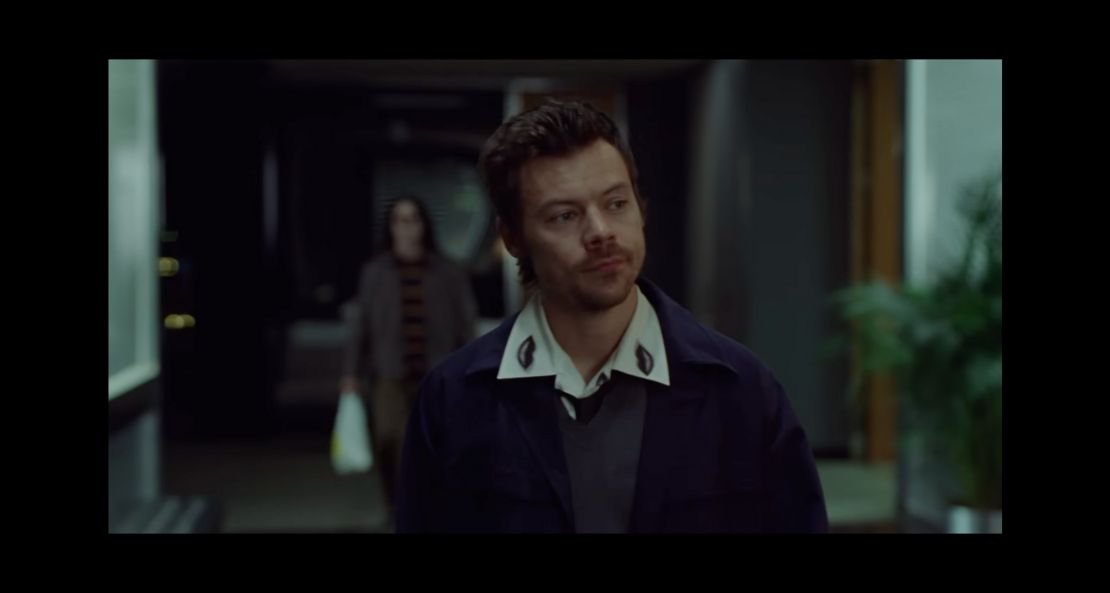
The video, directed by Aube Perrie, literalises this disconnect. Styles tumbles down brutalist concrete stairs, pursued then pursuing, before breaking into synchronised choreography with his attacker-turned-dance-partner.
The sequence plays like a fever dream of forced intimacy, bodies moving in unison whilst remaining fundamentally separate.
The setting (a massive, cold hotel that could exist anywhere and nowhere) mirrors the song’s paradox: surrounded by architecture designed for gathering, yet profoundly alone.
What makes “Aperture” quietly radical isn’t its sonic departure from Styles’ catalogue, though the shift from Laurel Canyon soft-rock to strobe-lit minimalism will dominate the discourse.
The radical gesture is releasing a lead single that refuses to perform reunion. Pop thrives on returns, on prodigal stars coming back with declarations and certainties.
Styles returns with a five-minute meditation on not quite connecting, on being present without belonging, on opening an aperture and still not letting the light in.
The cultural timing matters. “Aperture” arrives in a moment when we’re supposed to have moved past collective isolation, when clubs and stadiums fill again but the muscle memory of connection feels atrophied.
Styles spent his hiatus running a marathon, going to clubs to be in crowds rather than performing for them.
The song suggests he noticed what many noticed: returning to pre-pandemic rituals without recovering pre-pandemic ease, the strange flatness of trying to manufacture spontaneity when everyone’s operating from a script of how things used to feel.
The disco nod in the album title Kiss All the Time. Disco, Occasionally promises liberated hedonism but hedges with “occasionally,” as if even escapism requires scheduling now.
“Aperture” sounds like that hedge feels. It’s the awareness that letting light in also means recognising what the darkness was hiding.
For a song ostensibly about togetherness, “Aperture” spends most of its runtime alone with its thoughts.
The production builds and retreats, adds layers then strips them away, mimics the architecture of house music without committing to its transcendent purpose.
When the house-y pianos finally arrive near the end, they feel less like arrival than rehearsal, someone playing at the motions of ecstasy whilst keeping one foot outside the frame.
Styles’ strategic gamble with “Aperture” as a lead single makes sense only if you accept that he’s not interested in delivering the comeback spectacle expected of pop’s benevolent princes.
After four years away, he could have returned with immediate vindication, with a three-minute rush designed to flood the timeline and dominate the algorithmic churn.
Instead, he offers a song that requires adjustment, that withholds its pleasures behind a persistent, almost uncomfortable rhythm, that mistakes could interpret as boring when it’s actually being honest.
The question isn’t whether “Aperture” works as a comeback single by conventional metrics.
The question is what it signals about the album to follow, and what it reveals about the artist who chose it.
Styles has spent his solo career positioning himself as someone unafraid of sincerity in an ironic age, someone who could earnestly claim connection when cynicism felt safer.
“Aperture” suggests he’s stopped performing that certainty. The light gets in, but so does the doubt.
What remains most striking about “Aperture” is how the song ends as it began, with that insistent pulse, that repeated claim of belonging, that sense of someone still trying to talk themselves into believing.
The aperture stays open, but Styles never tells you what the exposure revealed.
You’re left with the beat, the mantra, the suspicion that the celebration might be the loneliest ritual of all.
You might also like:
- Harry Styles Forever, Forever: First New Music Since 2023
- Understanding the Depth of Harry Styles’ As It Was Lyrics
- The Meaning Behind Harry Styles Late Night Talking Lyrics
- Unravelling the Sweet Mystique of Harry Styles’ Watermelon Sugar
- Harry Styles Presents The Real Harry Styles In ‘Fine Line’
- The Meaning, References, and Influences Behind Taylor Swift’s Is It Over Now? Lyrics