
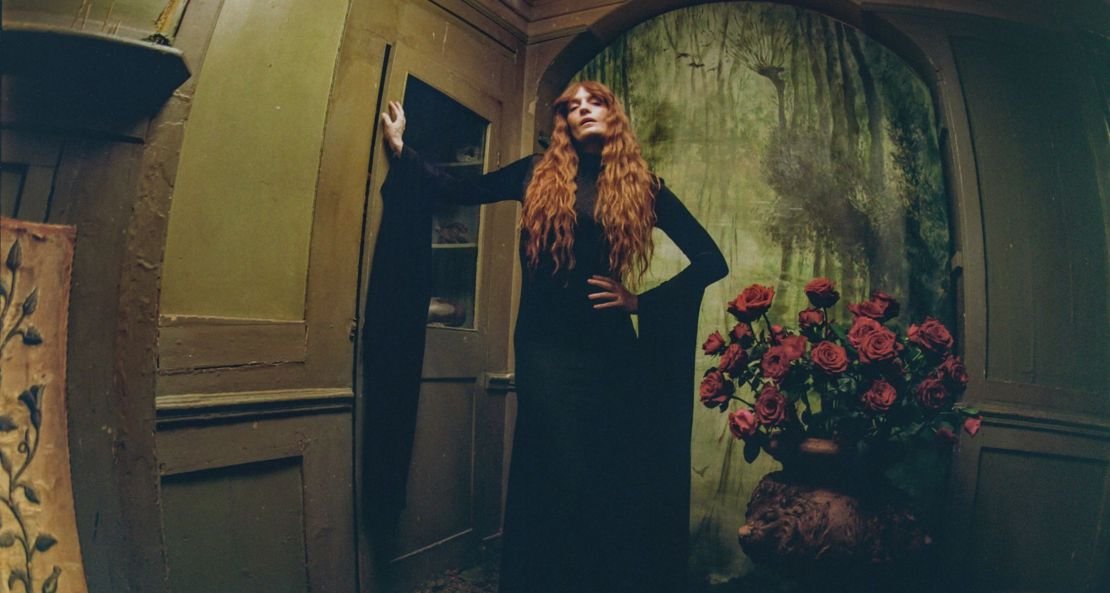
Florence Welch is singing from somewhere else now. Not the cathedral heights of Ceremonials or the sweating, euphoric climax of Dance Fever, but a quieter room. Stone walls, maybe. Candles instead of chandeliers. The kind of space where you whisper prayers instead of screaming them.
On 31 October 2025, she released Everybody Scream, her sixth studio album containing twelve tracks, with a deluxe edition expanding to sixteen.
The album arrived after a series of singles that felt less like promotional tools and more like dispatches from a private ritual: “Everybody Scream” in August, “One of the Greats” in September, “Sympathy Magic” in late October, and “Buckle” in early November.
But it’s the deeper album cuts that reveal the true architecture of this era: the chamber version of “Old Religion”, “Music by Men”, and “Perfume and Milk”.
None of them behave like conventional pop songs. They don’t build to explosive choruses. They don’t reach for radio.
Instead, they curl inward, dense with imagery that reads more like folklore than pop music. Milk as ritual offering. Religion as ancestral inheritance. Music as dangerous devotion. Water as both cleansing and drowning.
Fans have noticed. This isn’t just new music. It’s a shift in weather.
Florence Welch’s new era feels mythic but exhausted, like a priestess who’s been performing ceremonies for too long and finally sat down to question what she’s been worshipping.
The album’s songs are slower, stranger, more interested in what happens after the ritual ends than during the height of it. There’s less theatre here, and more aftermath.
It’s worth asking what changed. In August 2023, during the Dance Fever tour, Florence experienced an ectopic pregnancy that ruptured her fallopian tube.
She performed through it at a Cornwall festival, bleeding internally, popping ibuprofen backstage. Emergency surgery followed. One fallopian tube gone.
A door opening, as she described it, “full of women, screaming.” That rupture, both physical and spiritual, is the ground from which Everybody Scream grew.
Dance Fever was about bodies in motion, ecstatic release, the fear of stopping. High As Hope was reckoning with sobriety and softness.
But Everybody Scream doesn’t move like either of those albums. It sits still. It watches. It remembers old stories and wonders if they still apply. It asks what you owe to your art when your art nearly killed you.
Florence has always written like someone translating myths into modern feeling, but now the translation feels more deliberate. The symbols she’s using aren’t decorative.
They’re load-bearing. Milk isn’t just an evocative image in “Perfume and Milk”; it carries meanings of motherhood, purity, sacrifice, nourishment withheld or offered.
“Old Religion” doesn’t just reference the past; it embodies a kind of spiritual inheritance that feels both comforting and suffocating.
The symbolism explained across these tracks isn’t about solving a puzzle. It’s about recognising patterns that repeat across centuries of storytelling.
Water keeps appearing, but not the way it did in earlier work. In Ceremonials, water was drowning, overwhelming, a force that swallowed you whole.
Here, it’s quieter. More like standing in a river and feeling the current but choosing not to move. The danger is still there, but so is the stillness. Florence’s hidden meanings often live in that tension between movement and stasis, chaos and control.
The witch-poet element of her writing has always been present, but it’s sharpened now. She’s not performing witchcraft as aesthetic; she’s documenting it as practice.
The songs feel like they were written in sequence with something else: lighting candles, drawing symbols, speaking names aloud.
“Sympathy Magic”, the title itself, refers to the folkloric principle that like produces like. A doll made in someone’s image can affect the person. A song about longing can manifest longing. The act of singing becomes the spell.
Watch the official “Sympathy Magic” music video:
Mythology has threaded through Florence’s work from the beginning. “Shake It Out” referenced the dog days, a Roman belief about the hottest part of summer.
“What the Water Gave Me” borrowed from Virginia Woolf and Frida Kahlo in equal measure. But those songs used myth as metaphor.
Florence and the machine’s 2025 material uses it as structure. The songs don’t just reference old stories; they behave like old stories, moving with the logic of folk tales where repetition matters and symbols carry more weight than plot.
“Music by Men” interrogates devotion in a way that feels uncomfortably specific. It’s about loving something that doesn’t love you back, pouring yourself into art or people or ideals that take without giving.
The title itself is a quiet accusation. Not rage, exactly. More like documentation. A record of what was given and what was taken. The song doesn’t resolve. It just names the imbalance and lets it sit there.
“Old Religion”, especially in its chamber version, strips away the drama of the original recording and leaves something more skeletal. You can hear every breath.
The strings feel funereal but also careful, like they’re holding something fragile. The title refers to pre-Christian belief systems, but the song doesn’t romanticise them. It treats them as inheritance. Something passed down that you didn’t choose but can’t quite abandon either.
“Perfume and Milk” is the strangest of the collection. The imagery is domestic but unsettling. Milk as offering, as maternal duty, as something that can spoil.
Perfume as disguise, as seduction, as the thing that lingers after someone leaves. The two images sit together uneasily, creating a portrait of femininity that’s both nurturing and performed, both instinctive and exhausting.
The emotional through-line across these songs is fatigue. Not burnout exactly, but a spiritual tiredness that comes from years of performing intensity.
Dance Fever was about the fear of stopping. These songs are about what happens when you do stop. When the ritual ends and you’re alone with the candles and you have to decide if you believe in any of it anymore.
There’s something almost vampiric in how Florence describes the act of performing on tracks like “Drink Deep.” Not performance as transcendence, but as extraction.
Something that siphons life force, takes pieces of you each time you step on stage. The ritual doesn’t just exhaust you. It consumes you. And after nearly dying, the question becomes sharper: what are you willing to sacrifice? What do you owe?
The album charts a curious power dynamic. In performance contexts, on songs like the title track and “Witch Dance,” Florence presents herself as powerful, commanding, almost supernatural.
But in relationship contexts, on “Buckle” and “Kraken,” she’s weakwilled, easily wooed, comparing herself to an ornament hanging off someone’s jeans.
It’s the same person, but the contexts reveal different versions. The woman who can command a stage becomes small in the face of flattery. The witch who screams becomes quiet in intimate rooms.
There’s a tension between purity and chaos that runs through all the Florence the Machine analysis of this era.
The imagery is often clean: milk, white dresses, stone altars, clear water. But the emotions are messy: grief that won’t resolve, love that consumes, devotion that borders on self-destruction. The contradiction isn’t accidental. It’s the point. Purity is a performance. Chaos is what’s underneath.
Compared to earlier work, the emotional maturity here is startling. High As Hope was about learning to be softer.
This is about learning when softness isn’t enough. It’s about recognising that some patterns repeat because they’re woven into the fabric of who you are, not just bad habits you can quit.
Sonically, everything is quieter. Florence’s voice, which has always been a force of nature, sounds more exposed here.
There’s less reverb, fewer layers, less armour. The chamber arrangements on “Old Religion” make the song feel like it’s being performed in a small room rather than a concert hall.
You can hear the strings breathing. The space between notes matters as much as the notes themselves.
But quiet doesn’t mean safe. On “Sympathy Magic”, Florence delivers something borderline unhinged.
The virtuosity is there, the power, the volume, the presence. But she sounds desperate. Out of her mind.
The woody percussion timbres, the scattered orchestral flourishes, the stomping that sounds like ritual, all of it supports a vocal performance that’s barely contained.
It’s the sound of someone who’s stopped playing it safe because playing it safe didn’t protect her from harm anyway.
Working with producers Aaron Dessner (The National), Danny L Harle, and Mark Bowen from IDLES across Everybody Scream, Florence has crafted something that doesn’t rely on explosive drama.
Bowen’s influence particularly shows on “One of the Greats,” where scuzzy, slow, driving guitars create the kind of sad rock atmosphere IDLES has perfected.
It’s not about reaching a crescendo. It’s about sustaining a low, constant intensity that’s somehow more exhausting than loudness.
The stripped-back production makes every word land harder. When Florence sings about milk or religion or men’s music, you hear it without decoration. Just voice and meaning and the uncomfortable intimacy of both.
The acoustic restraint of “Buckle” offers something fans have wanted from Florence for years: a genuinely tender moment that explores the softer registers of her voice without theatrical embellishment. It’s a small song on an album of rituals, and its smallness matters.
Fans online have been piecing together theories with the dedication of scholars. Reddit threads dissect the mythic mother witch symbolism, noting how Florence positions herself as both creator and destroyer, nurturer and oracle. TikTok users have created entire aesthetic boards around the “Sympathy Magic” era, all milk baths and candles and tarot cards.
YouTube comments describe these songs as private rituals you’re not supposed to witness, ceremonies happening behind closed doors that somehow got recorded.
The comparison that keeps appearing is to early Lungs-era Florence but with grown-woman clarity.
That debut album had the same mythic intensity, but it was wilder, less controlled. The new material has that intensity filtered through years of actually living with these symbols.
It’s not play-acting witchcraft. It’s documenting what happens when you’ve been the witch so long you can’t remember who you were before.
In 2025, listeners are drawn to mystical, symbolic pop in ways they weren’t even five years ago. The rise of tarot as mainstream practice, the rediscovery of folk magic traditions, the hunger for art that feels ritualistic rather than consumable.
Florence’s writing sits perfectly in that intersection of poetry, folklore and emotional confession. It’s not quite pop, not quite art music, not quite anything easily categorised.
TikTok has created space for what you might call art-pop with ritualistic intimacy. Songs that feel like spells, that demand you sit still and pay attention, that refuse easy resolution.
Florence has always made that kind of music, but the audience for it has grown. What felt niche in 2009 feels necessary now.
This era feels more intimate and less theatrical because it is. The previous albums were often about grand emotions: huge love, devastating loss, ecstatic release.
These songs are about the smaller, stranger feelings that don’t have easy names. The exhaustion of performing devotion.
The loneliness of maintaining ritual when you’re not sure if it works anymore. The grief that doesn’t announce itself but just quietly takes up residence in your chest.
The album moves through emotional terrain with intention. It opens with celebration, the title track asserting what Florence becomes when she performs.
Then it shifts into self-examination on “One of the Greats,” questioning whether the sacrifice has been worth the accolades.
The middle section explores relationship dynamics, power imbalances, the ways we make ourselves small or allow ourselves to be consumed.
By “You Can Have It All,” near the album’s end, there’s a sense of surrender. Everything given up, everything sacrificed.
The final track seeks calmer waters, less turbulence. It feels more like meditation than song, a musical manifestation of someone trying to find peace after the storm.
There’s a sense throughout Everybody Scream that Florence is creating from inside a sanctuary she built for herself.
Watch the official “Everybody Scream” music video:
Not hiding exactly, but working in a protected space where she can be honest about what the mythology actually costs.
The songs don’t feel like they were written for an audience. They feel like they were written for her, and we’re being allowed to listen in.
This era feels transitional in the truest sense. Not a detour, but a necessary passage between one state and another.
The symbolism she’s leaning into suggests larger work ahead. When artists start stripping things down, getting quieter, examining the foundations, it usually means they’re preparing to build something new.
These songs feel like clearing the ground. Marking the perimeter. Deciding what stays and what gets burned away.
What comes next will likely dig deeper into the territory Everybody Scream has mapped. More mythology, but personal rather than borrowed.
More ritual, but honest about what it costs. More quiet intensity instead of explosive drama. Florence has always been at her best when she’s following her instincts into stranger territory, trusting that listeners will follow.
For now, we have this album. Twelve tracks that feel like candles in a dark room. Twelve spells that don’t resolve but just sit there, glowing, waiting to see what they’ll summon next.
You might also like:
- Florence + The Machine “Sympathy Magic”: Survival is a Ritual
- The Old Religion (Chamber Version) Review – Florence + Machine
- Florence + The Machine “Music by Men” Lyrics Meaning
- Florence + The Machine “Perfume and Milk” Lyrics Meaning
- Florence + The Machine “One Of The Greats” — Song Review & Lyrics Meaning
- Dog Days Are Over by Florence and the Machine: How a Hangover Inspired a Song of Hope and Freedom