
“2.0” feels like a post-military reclamation track, a trap-heavy statement off their 2026 album ARIRANG framed as an upgrade rather than a return. Same group, new specs, and considerably less patience for anyone who assumed the gap year was a retreat.
Track 5 on ARIRANG, placed after the kinetic chaos of “FYA” and before the album’s more introspective second half, “2.0” arrives with Mike WiLL Made-It’s 808 bass sitting low and controlled, hitting on the “pop” and the “knock” without cluttering the space around those moments. That gap is load-bearing. “Pop. Knock. You know how I do.” The phrases land because of what isn’t between them.
The Korean opening establishes the tone before the trap drops in. SUGA enters with the group’s own branding: “방탄처럼, 그게 말은 쉽지” (“Sure, like Bangtan, easy to say”), not as a victory lap but as a challenge to the comparison itself. Then comes the image that runs underneath everything else on this track: “우린 뜀틀, 누가 맨날 뛰어넘니?” (“We’re the vaulting horse, who keeps clearing us?”). In gymnastics, the vaulting horse doesn’t move. It stays exactly where it is and waits for whoever thinks they can get over it. BTS have spent a decade watching people use that benchmark while being told they’d eventually fail to clear it themselves. This lyric isn’t defensive. It’s geometric.
RM takes that logic further by dismissing the decade entirely: “10년은 말야, 어림 반 푼어치” (“Ten years isn’t worth even half a fraction”). Past success buys nothing here. The clock restarts at zero, which means zero anxiety about what came before.
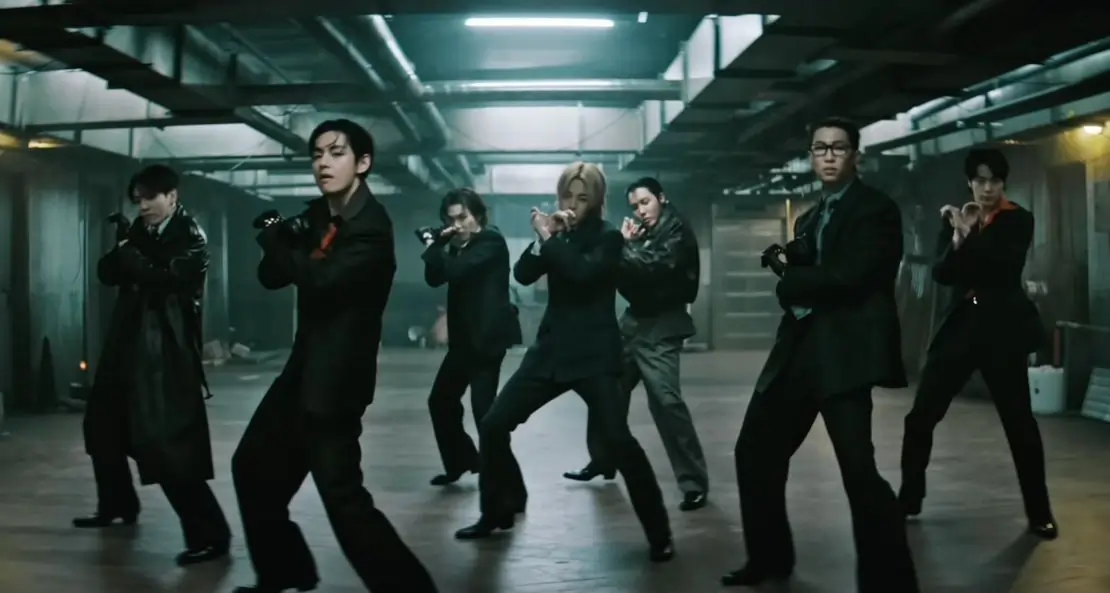
The music video, directed by Hangyeol Lee and built around Park Chan-wook’s Oldboy visual language, connects the dots. All seven members exit a battered elevator in suits and leather jackets, walk into a corridor of waiting thugs, and deal with the confrontation through choreography instead of violence.
In Oldboy, Oh Dae-su drags himself through a nearly identical hallway with a hammer, barely surviving, in one of cinema’s most exhausting depictions of endurance.
BTS walks in and turns the same space into a performance. Same hallway, different weapon. Nobody bleeds, and that gap between what the scene promises and what it delivers is where the video does its actual work.
One factual note: the homage to Oldboy is explicit and confirmed. Park Chan-wook’s direct involvement in the video’s production has not been. Worth knowing before building a critical argument on that connection.
What makes the corridor sequence land is what the choreography refuses to do. Head level steady while limbs move. Footwork exact but not layered into spectacle. Isolations and stops that hit the kick drum rather than the obvious melodic peaks. The lighting syncs to the bass, flickering with the track’s rhythm, and that alone is doing structural work most K-pop MVs assign to full lighting rigs and post-production.
Then the humour arrives. Jimin and V are wearing fake beards. Jungkook is doing something with his eyebrows that is a direct lift from actor Jung Woo-sung’s signature expression. The thugs are carrying a hyojason (a traditional Korean back scratcher), a taegeuk fan, and a danso flute. A newspaper is held upside down. These aren’t sight gags laid on top of a serious video. They’re the video confirming it knows exactly how strong the atmosphere is, strong enough to hold absurdity without deflating. That’s a harder balance than it looks.
The bathroom sequence loosens things before the second elevator ride tightens them. “2.0 Loading” appears on screen. Suits come off. Sleek streetwear goes on. The structure travels bottom to top: gritty basement corridor to penthouse high-rise, and the transformation is visible without being explained. You see them go down, you see them come up changed, and the elevator metaphor is complete before anyone narrates it.
There’s a case to be made that “pop pop pop” repeated five times is thin on the page. Reading the lyric sheet, it looks like a placeholder. But over a Mike WiLL 808 drop, it stops being a lyric and starts being a percussion instrument that happens to use a word. The track was built around impact and placement, not verse craft, and it works on exactly those terms.
“2.0” debuted at No. 50 on the Billboard Hot 100, sitting below ARIRANG‘s stronger commercial performers. ARIRANG and lead single “SWIM” had already debuted simultaneously at No. 1 on both the Billboard 200 and the Hot 100, a feat very few artists achieve in any given week. “2.0” doesn’t need to top that. It needs to make the chart position feel like the least interesting thing about them.
It does.
You might also like: