

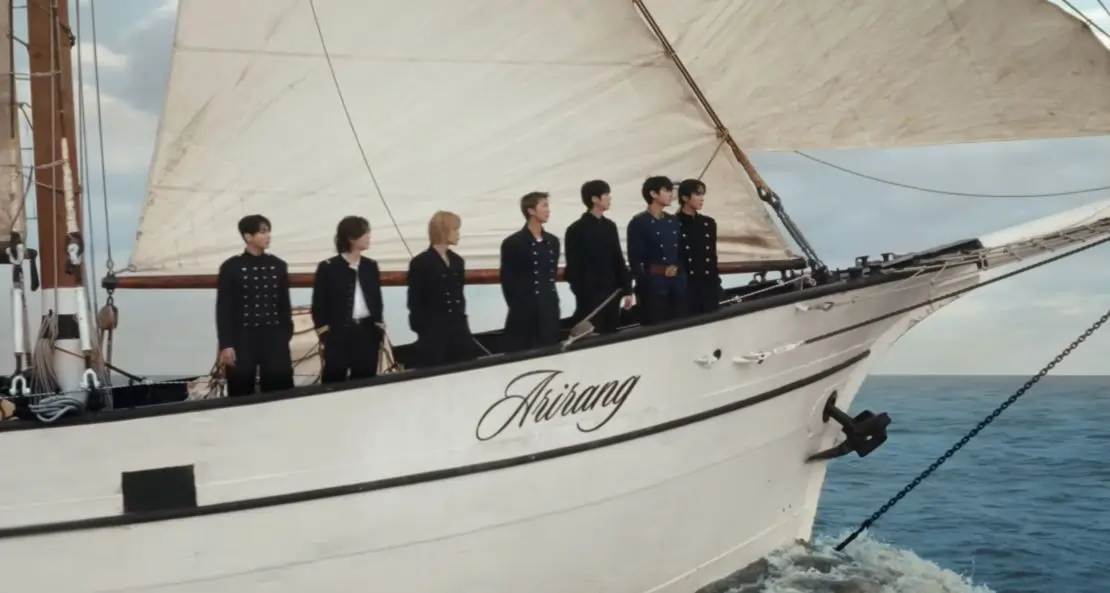
BTS’ “SWIM” is a comeback song about emotional survival, using water as a metaphor for time, change and staying grounded in love. It reflects the group’s return after military service, choosing movement over control and connection over certainty.
BTS were gone for nearly four years. This is what they came back with.
BTS returned on March 20, 2026 with ARIRANG, their first album since mandatory military service separated all seven members. Its lead single, “SWIM”, is a sun-bleached, deliberately slow-moving pop track that uses water as a sustained metaphor for accepting life’s pace rather than fighting it, and for finding your anchor in another person when the current gets heavy. It’s also two-and-a-half minutes long, has no bridge, and was almost not the title track.
What Is “SWIM” About?
“SWIM” is a love song built around the idea of emotional survival. The sea is life, the current is time, and diving in rather than standing frozen on the shore is the song’s central argument. BTS described it in their press release as “a song that mirrors life itself,” one that encourages listeners to move through each day at their own rhythm rather than someone else’s. Jimin put it plainly ahead of release, telling fans via Spotify: “Like a current that never stops flowing, we wanted to show that we are still moving forward, at our own pace.”
The song folds personal love into something wider. You don’t have to master the sea. You just have to swim.
“SWIM” Lyrics Breakdown: Verse by Verse
RM opens the track with a verse that’s restless and slightly unravelling. “Bad world, gone away and I still wake up in this mad world” sets up a narrator who hasn’t adjusted to reality yet, someone who went away and came back to find nothing waiting where he left it.
He follows that with “name a place that I could breathe on this map, world,” it lands like an actual question, not a performance. “I’m in the deep, tell me where the hell you at, girl?” closes the verse on genuine lostness rather than performed cool.
The woman he’s addressing is both romantic and metaphorical. Being in the deep without her is about desire, but it’s also about disorientation after a long absence from your own life.
Jungkook’s pre-chorus drops the restlessness and replaces it with surrender. “So easy, don’t make it so hard / nights like these, I just wanna get lost / right here with the moon and the sharks” pulls the song into a looser emotional space. He isn’t trying to solve anything. He just wants to be in the water. It’s a permission slip before the chorus arrives.
The chorus is where “SWIM” makes its real case. “Water falling off your skin / I could spend a lifetime watching you” is repeated across four different vocal pairings throughout the song: Jungkook with Jimin, Jimin with V, Jungkook with Jin, then V with Jin in the final run. Each version sounds genuinely different.
Jungkook and Jimin together are warmer, almost domestic. V and Jin bring a slightly more fragile quality, wider and less anchored.
By the time all seven voices have moved through the same lines, the chorus has accumulated rather than repeated. It doesn’t feel like the same hook four times. It feels like four different people meaning the same thing.
SUGA’s verse is the most direct on the whole track. “Sittin’ on the shore, now I’m ready for the whole sea” is the album’s thesis compressed to one line, a statement about where BTS are after the hiatus, written without metaphor or performance.
“I ain’t never gettin’ cold feet” and “you’re the only place that I wanna be” close out his section with a clarity that the rest of the song doesn’t always reach for.
J-Hope’s verse is the loosest, most kinetic contribution. “Splash, drift / I make waves with my two fins” puts him already submerged while the others are still approaching the water.
“Under here, we don’t chase the time / baby, everything can’t be so sad” is the verse’s emotional turn, a direct push against despair that sits slightly apart from the rest of the song’s more contemplative tone.
Given that j-hope was filmed soaked through for three consecutive days during a real Atlantic storm in Lisbon, the lines about being fully in the water land with added impact.
The final chorus swaps “this is how it all begins” for “let it all begin,” a small change that shifts the song from observation to instruction.
The Music Video Explained: What Is Lili Reinhart Doing There?
The “SWIM” music video was shot in Lisbon, Portugal, directed by Tanu Muino, who also directed Jungkook’s “Standing Next to You”, over three days in the middle of a genuine Atlantic storm. The rain isn’t a production decision. It’s actual Portuguese weather.
Lili Reinhart carries roughly 50 to 60 percent of the screen time. She is not a cameo. The video opens on her in a maritime museum, studying model ships, before she wakes up aboard a sailing vessel with BTS.
From that point, BTS work the rigging, steer, keep watch. She moves through the experience as the central figure. They are working for her. She has the foreground. They’re behind her, keeping the ship moving.
Whether Reinhart represents ARMY, with the group literally steering on the fanbase’s behalf, or whether it’s simply a decision to pull focus away from the expected idol format, both interpretations hold.
Either way it’s an unusual choice for a group comeback video. The members admitted in behind-the-scenes content they knew it would draw criticism. They chose it anyway.
The styling reinforces the nautical storybook world. Jin’s long blonde hair and white shirt carry a clear Peter Pan energy. V’s suspenders and moodier styling push toward something between emo pirate and bad boy sailor. The wet hair and soaked outfits throughout aren’t just aesthetic. They put the group physically inside the song’s central metaphor.
There’s no lip-sync, no dance break, no stage. Whether that confidence is justified or optimistic is worth questioning.
Who Produced and Wrote “SWIM”?
Production is credited to Tyler Spry and Leclair. The songwriting credits are extensive: James Essien, Sean Foreman, Tyler Spry, Jamison Baken, Ryan Tedder, RM, Kirsten Spencer, Derrick Milano, and Pdogg.
Pdogg, the Korean producer whose fingerprints are on BTS’s entire pre-Butter catalogue, is credited here too. That credit largely got lost in the discourse around ARIRANG being a Western-facing production.
His presence matters because it means the album’s connection to the group’s earlier identity isn’t entirely gone. It’s just less prominent than many were expecting.
“SWIM” sits at Track 7 on ARIRANG’s 15-track listing. The album’s midpoint.
Why Did BTS Choose “SWIM” as the Title Track?
The members themselves weren’t sure. According to fan accounts from a pre-release listening event, there was genuine internal debate about whether the song was too understated for the occasion. They chose it anyway, and that decision deserves harder scrutiny than it’s received.
BTS returning after a four-year military hiatus is not a normal comeback. The expectation, built not just by fans but by the weight of what that gap represents, was for something that acknowledged the scale of the moment.
“SWIM” actively doesn’t do that. It’s two-and-a-half minutes long with no bridge, no traditional climax, and no K-pop infrastructure of any kind.
Multiple self-identified ARMY members posted in review forums that they felt shortchanged by the title track choice, even while praising album cuts like “FYA”, “Body to Body”, and “One More Night”.
The argument for the choice is that BTS made the comeback that reflected where they are now rather than the one that would satisfy where fans wanted them to be. That’s a legitimate creative position.
The argument against it is that a lead single doesn’t just represent the artist. It represents the album to everyone who might not go deeper.
If your entry point to ARIRANG is “SWIM”, you might reasonably conclude there’s nothing more urgent inside. The song doesn’t pull you toward the record. It asks you to be patient with it. After four years, that’s a lot to ask of a casual listener.
Whether BTS got this decision right is genuinely unclear. The artistic logic is there. The commercial instinct is debatable.
The Arirang Connection
The album title is not decorative. Arirang is Korea’s most recognised traditional folk song, a song of longing, separation, and perseverance that has existed in hundreds of regional variations for centuries.
UNESCO listed it as an intangible cultural heritage. Its themes map directly onto what BTS experienced: forced separation, the pull to return, an identity rooted in something older than the industry that shaped them.
Naming a comeback album Arirang and choosing an English-language pop song as its lead single drew pointed criticism.
The gap between what the title promises and what “SWIM” delivers sonically is real. What closes that gap, if anything, is BTS’s stated intention: they want “SWIM” to work the way Arirang has historically worked, as a song passed between people that stays close to them over time, across generations.
Whether a two-and-a-half minute co-write can carry that kind of cultural longevity is the question the comeback has placed on the table. The ambition is genuine. The ask is enormous.
You might also like:
- BLACKPINK – DEADLINE Review: The Four Who Write Their Own Rules
- Harry Styles’ Kiss All the Time. Disco, Occasionally Review: The Disco Album That Barely Wants to Dance
- James Blake – Trying Times Review: Flawed, Stunning, and Unmistakably His
- Slayr – Half Blood (BloodLuxe) Review | Best Underground Rap Album of 2026?