

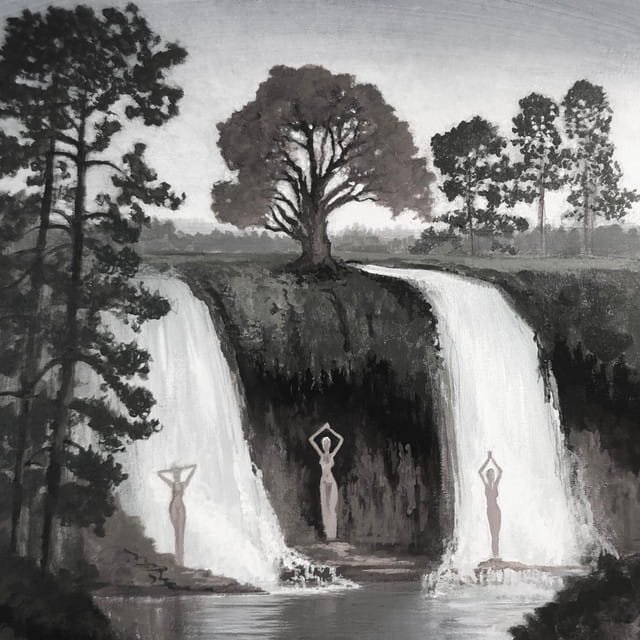
The smartest thing Sons of Town Hall do in “Sirens” is cast someone else as the sirens.
The track, taken from the forthcoming album Of Ghosts and Gods, features Canadian vocal trio The Pairs as the mythic voices offering rest, comfort and company to travellers on a long road who probably shouldn’t stop.
It’s a clever inversion. Instead of temptation coming from outside the story, it arrives embodied, warm, almost reasonable.
The Pairs open a cappella. No guitar. No production. Just three-part harmony dropped cold into the track.
It works because it is slightly eerie before it is beautiful, which is the correct order for a song about creatures who sing sailors onto rocks. The harmonies are pure but carry a slight tensile edge, more invocation than lullaby.
When the acoustic guitar enters and Berkeley and Parker take the verses, the register shifts immediately.
Where The Pairs are smooth and deliberate, the duo sound earthbound, a little frayed. “We know the road is long and hard, and there’s always more dust and thorns / Won’t you lay your hand upon my worried brow.” On the page that risks sounding theatrical. In the voice, it lands as fatigue speaking to fatigue.
The second chorus introduces piano and violin alongside The Pairs, and the arrangement opens outward. Not bigger exactly, but more exposed.
When the song then strips back to guitar for the returning verse, the move should feel like a retreat. It doesn’t.
The duo have described “Sirens” as one of the record’s emotional anchors, exploring temptation, longing and the pull of distant shores through layered harmonies and restrained instrumentation.
That framing is audible in the architecture. The swell of harmony and strings feels like surrender, like the traveller leaning into the offer. But the reason the later reduction back to guitar does not break the spell is structural rather than decorative.
By the time the arrangement thins, the emotional shift has already occurred. The warmth has entered the room. Stripping the instrumentation only isolates that feeling further. The song is not chasing grandeur. It is staging intimacy.
The crucial line arrives almost casually: “I’ve been a long time alone.” It reframes every invitation that precedes it.
The sirens are not predators circling ships. They are isolated voices calling across distance. The danger isn’t malice. It’s mutual need.
That is the craft here. Not the mythic framing. Not the concept. The emotional repositioning.
By the end, the question is no longer whether the traveller should stop. It’s whether either side can afford not to.
You might also like:
- Nathan Evans Wellerman Lyrics: The Story Of A Viral Sea Shanty
- The Crane Wives: The Well Is An Evocative Folk Ballad
- Ocie Elliot’s Come On By: A Soulful Sojourn Of Longing And Connection
- Exploring the Soulful Melodies: The Unique Charm of Indie Folk Music
- Mumford & Sons: A Journey Through Their Greatest Hits
- Top 10 60s Hits That Shaped Folk Music


