

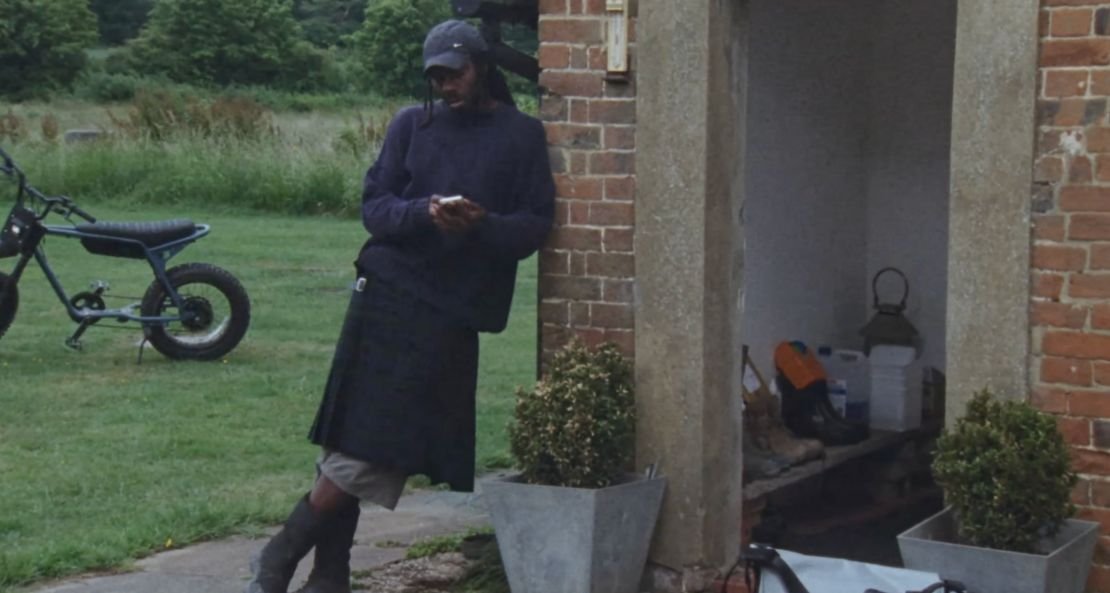
After three years of silence under his Blood Orange moniker, Dev Hynes returns with “The Field,” a track that refuses to shout for your attention yet won’t let you look away.
Released 26 June as the lead single from Essex Honey, the song marks something more significant than a comeback. It signals a homecoming.
Hynes described the song as being about “deep breaths in country fields & the ones we miss when we close our eyes,” and that pastoral longing permeates every element of the production.
What immediately strikes you is the tension between stillness and motion. The track opens with plucked acoustic guitar courtesy of The Durutti Column‘s Vini Reilly, sampled from his 1982 composition “Sing to Me.”
That gentle English post-punk heritage gets disrupted by skittering jungle-esque percussion that refuses to settle into predictable patterns.
The drums dart and skip, creating restless energy beneath the surface calm.
Caroline Polachek, Daniel Caesar, and Tariq Al-Sabir weave their voices through the arrangement with the delicate precision of people handling something fragile.
Polachek’s ethereal presence has rarely felt more necessary than when she sings “in the heat of the sun” over Hynes’ Arthur Russell-style cello passages.
The instrumentation maintains this balance throughout: warm, organic textures constantly pulled against electronic intervention, as if the track itself can’t decide between pastoral retreat and urban anxiety.
What “The Field” Actually Means
The lyrics circle grief, displacement, and the difficulty of letting go. “Hard to let you go / See you and I know why it’s always grey” acknowledges how loss colours everything, turning even bright days dim.
But the repetition of “Sing to me / In the heat of the sun / When the day is done” suggests something else: the desperate need for comfort, for someone’s voice to anchor you when you’re unmoored.
“Healthy as we pray for a journey home” reveals the song’s true weight. This isn’t just about missing England’s fields.
It’s about searching for home after losing the person who made anywhere feel like home.
Hynes lost his mother during the six years between Negro Swan and Essex Honey. That grief sent him back to England, back to Essex, back to fields where memory and landscape blur together.
The John Constable painting chosen for the single’s cover art reinforces this. Golding Constable’s Flower Garden (1815) depicts an English garden with meticulous attention to light and atmosphere.
Constable painted places he knew intimately, transforming familiar landscapes into something precious through the act of observation.
Hynes does the same here, taking the fields of his childhood and making them sacred through absence and longing.
You might also like:
- Best R&B Songs 2025: 10 Tracks Reviving Real R&B
- Robyn’s “Dopamine” Review, Meaning & Video Breakdown
- Odeal “Addicted” Review: 80s Soul Meets Modern Desire
- Tems’ “Lagos Love” Review: Afropop Soul Meets Vulnerability
- ROSALÍA LUX Album Review: A Daring Orchestral Gamble
- Geese’s “Taxes” Review & Lyrics Meaning
A Return to English Roots
For an artist who spent fifteen years soundtracking New York City’s streets and clubs, the shift to English countryside imagery feels startling.
His previous Blood Orange albums existed deep in Brooklyn’s cracks and Manhattan’s drag clubs.
Cupid Deluxe literally sampled the sounds of New York. But “The Field” trades all that urban texture for seagulls and rain, camping gear and raves in muddy fields.
The music video, directed by Hynes, follows a couple packing a Peugeot 309 and roaming drizzle-soaked landscapes before culminating in the most British conclusion imaginable: a rave in a field in the rain.
It’s absurd and perfect, capturing something about English youth culture that rarely makes it into art this thoughtful. The joy exists alongside the melancholy, not despite it.
Hynes’ production choices support this tonal complexity beautifully. The percussion could soundtrack a club at 3am, but the guitar and cello pull you back to something quieter, more contemplative.
It’s too dreamy to be a club track and too restless to be a lullaby, existing instead in that strange in-between space where Blood Orange has always thrived.
Processing Grief Through Sound
“The Field” refuses easy catharsis. There’s no climactic release, no moment where the pain resolves into peace.
Instead, Hynes offers acceptance: “feel it every day / and the sun keeps you warm.” The loss remains, but so does life, continuing despite everything. Critics have taken notice.
The track appeared on several year-end lists including The Guardian’s best songs of 2025, but the recognition feels secondary to what the song actually achieves.
Musically, “The Field” demonstrates how genre boundaries have become meaningless for artists willing to trust their instincts.
This is simultaneously indie folk, electronic R&B, post-punk revival, and something entirely its own. The Durutti Column sample connects it to Factory Records’ experimental spirit. The jungle drums recall UK garage’s golden era.
The cello arrangements nod to Arthur Russell’s downtown New York experimentalism. But somehow it all coheres into something distinctly Blood Orange, distinctly now.
After a year where Hynes was “lost and overcome with grief,” unable to see a path forward creatively, “The Field” stands as proof that sometimes you have to go back to move forward.
The English countryside Hynes left behind became the space where he could process what he’d lost in New York.
The fields aren’t just setting. They’re the actual subject: blank canvases where memory and emotion can exist without the city’s constant noise.
“The Field” never explains itself. Never offers solutions. You stand in that field, take a breath, and realise the people you see clearest with your eyes closed are exactly the ones you’ll keep singing to, knowing they’ll never answer.