
Bad Bunny opened his sixth studio album DeBÍ TiRAR MáS FOToS with something nobody saw coming. “Nuevayol” (released 5 January 2025) isn’t another reggaeton banger or trap experiment.
It’s a full-throated celebration of classic salsa, wrapped in nostalgia and delivered with political conviction that feels both necessary and risky.
The track samples “Un Verano En Nueva York” by El Gran Combo de Puerto Rico, the legendary salsa orchestra that defined Puerto Rican music in the 1970s.
Bad Bunny doesn’t just reference the original; he rebuilds it from the ground up, keeping Andy Montañez’s vocals from the 1979 classic intact whilst threading his own verses between the choruses. The result feels less like a remix and more like a conversation across decades.
What Nuevayol Actually Means
The title itself tells you everything about Bad Bunny’s approach. “Nuevayol” spells out “New York” in a Puerto Rican accent, where the final “k” sound drops off and the “r” softens into an “l”.
It’s how Puerto Ricans who migrated to New York in the mid-20th century would have pronounced it: a linguistic marker of identity that carries decades of cultural history in just three syllables.
Bad Bunny opens the video walking through snow-covered streets in sandals, shivering and muttering “¿Y este frío?” (And this cold?).
It’s a visual callback to the immigrant experience: arriving in New York unprepared for winter, displaced but determined.
The image recalls countless stories of Puerto Ricans who moved to the Bronx, Washington Heights, and Spanish Harlem searching for better opportunities, only to find themselves navigating a city that felt both promising and hostile.
The Sound: 70s Salsa Meets Modern Production
Musically, “Nuevayol” lives in two eras at once. The production team (MAG, Justi Barreto, and La Paciencia) kept the lush orchestration of the original salsa track but updated the low end for streaming platforms.
The result doesn’t sound dated, but it doesn’t sound contemporary either. It occupies a strange, effective middle ground where your grandmother could dance to it at a wedding whilst your younger cousin adds it to their workout playlist.
Bad Bunny’s first verse drops on the 4th of July, a deliberate choice that grounds the song in American independence whilst highlighting Puerto Rico’s complicated relationship with the United States.
He raps about hanging with his cousin in the Bronx, getting high in Washington Heights, and referencing Willie Colón (the salsa legend who defined New York’s Latin music scene in the 1970s).
The line “Willie Colón, they call me ‘The Bad One'” works on multiple levels. Willie Colón earned the nickname “El Malo” (The Bad One) for his rebellious approach to salsa.
Bad Bunny claims that lineage directly, positioning himself as the heir to a tradition of genre-bending Puerto Rican artists who refused to play by industry rules.
His flow switches between sung melodies and staccato rap cadences, always riding the clave rhythm that defines salsa.
When he drops “Selling albums like Frida Kahlo paintings,” the comparison isn’t random. Kahlo’s work became valuable precisely because it refused to compromise its cultural specificity for broader appeal. Bad Bunny’s making the same bet.
The Video: Wedding Aesthetics and Political Statements
The video dropped on 4 July 2025. Director Stillz shot it like a home movie from a 1970s Puerto Rican wedding reception.
The colour palette leans into faded pastels (whites, pinks, and earth tones) that recall old family photographs.
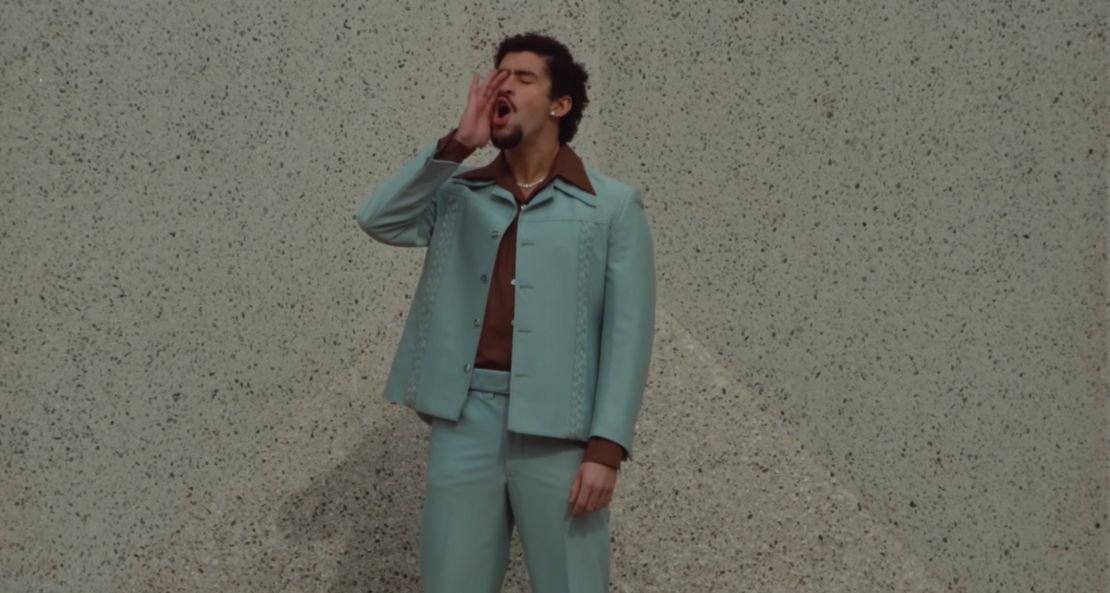
Bad Bunny wears a brown suit that would look perfectly at home in archival footage from El Barrio. Background actors play dominoes at plastic tables whilst others dance in cramped apartments that feel lived-in rather than art-directed.
The aesthetic isn’t just nostalgic; it’s specific. This looks like actual Puerto Rican family gatherings from that era, complete with the slightly awkward formal wear and the mix of generations sharing the same space.
Nothing about the video feels sanitised or designed for Instagram. It commits to an unglamorous authenticity that most music videos actively avoid.
Then comes the political moment that’s sparked most of the conversation around the track. Around the three-minute mark, a voice that sounds remarkably like Donald Trump’s crackles through a vintage radio.
The message it delivers: “I made a mistake. I want to apologise to the immigrants in America. I mean the United States. I know America is the whole continent. I want to say that this country is nothing without the immigrants. This country is nothing without Mexicans, Dominicans, Puerto Ricans, Colombians, Venezuelans, Cubans.”
Bad Bunny’s team hasn’t confirmed whether the voice was AI-generated or voice-acted, but the intent is clear.
Released just as Trump’s second administration ramped up ICE deportations and detention facilities, the moment hits with uncomfortable precision.
The delivery mimics Trump’s cadence perfectly (the pauses, the corrections, the casual cruelty of his usual rhetoric) but inverts the message entirely.
The Politics: Nuance in an Election Year
The satire lands precisely because it doesn’t announce itself with fanfare. The video doesn’t cut to Bad Bunny’s reaction or add visual emphasis.
The radio just plays the message whilst people continue dancing at the party. Life goes on. The point isn’t to centre the political moment but to embed it in the cultural celebration happening around it.
Bad Bunny’s been vocal about immigration issues before. In June 2024, he posted videos of ICE officers detaining people in Puerto Rico, calling them “sons of bitches” for disrupting communities.
During the 2024 presidential election, he shared a powerful video defending Puerto Rico after comedian Tony Hinchcliffe called the territory “garbage” at a Trump rally.
What makes the “Nuevayol” moment different is the method. Rather than direct confrontation, he uses satire: forcing Trump’s voice to speak truths the actual man would never acknowledge.
It’s more sophisticated than a straightforward protest song, but it’s also potentially less effective. The people who most need to hear the message probably won’t engage with a salsa-reggaeton track sung primarily in Spanish.
Still, the approach matters. Bad Bunny told Rolling Stone earlier this year: “People are used to artists getting big and mainstream and not expressing themselves about these things, or if they do, talking about it in a super careful way. But I’m going to talk, and whoever doesn’t like it doesn’t have to listen to me.”
That philosophy runs through “Nuevayol” from start to finish. The song doesn’t code its politics or hide them in metaphor. It states them plainly whilst dancing to a salsa rhythm that predates most of the current political tensions by decades. The juxtaposition creates space for celebration and protest to coexist without one diminishing the other.
Cultural Context: Salsa’s Long Memory
The choice to sample El Gran Combo de Puerto Rico isn’t arbitrary. The group formed in 1962 and became one of the most successful salsa orchestras in history, touring internationally and helping spread Puerto Rican music across Latin America and the United States.
“Un Verano En Nueva York” captured the experience of Puerto Ricans who had already established communities in New York by the late 1970s (people who were no longer immigrants but weren’t quite seen as Americans either).
Bad Bunny’s using that song as a foundation to talk about issues that haven’t changed in the intervening 45 years. Puerto Ricans still navigate complicated relationships with American identity.
They’re US citizens who can’t vote in presidential elections if they live on the island. They face discrimination despite their citizenship status. They watch their home get devastated by hurricanes whilst aid gets withheld or mismanaged.
“Nuevayol” doesn’t lecture about any of this. It just recreates the feeling of a summer evening in the Bronx circa 1979, when salsa was the sound of survival and community, when Puerto Ricans carved out space in a city that barely tolerated their presence.
The song argues that joy and resistance have always been intertwined in Puerto Rican culture, that dancing isn’t separate from politics but another form of it.
The Second Verse: Hip-Hop References and Baseball Metaphors
Bad Bunny’s second verse shifts gears musically, dropping the salsa sweetness for harder percussion and quicker flows.
He references Lápiz Conciente’s “Capea El Dough” (a Dominican dembow track about hustling and proving yourself).
The comparison positions Bad Bunny within a broader Caribbean hip-hop tradition that includes Dominican, Puerto Rican, and Cuban artists who’ve built parallel movements outside mainstream American rap.
The line “Back and forth, ping-pong / With a silencer, we steal the girls, James Bond” plays with spy movie imagery whilst keeping the playful tone.
Then comes the baseball reference: “I’m in my zone, I’ve got no rival, no / With the Yankees and the Mets, Juan Soto / Run, ’cause we’re knocking it out of the park again.”
Juan Soto’s a Dominican baseball superstar who plays for the New York Yankees, one of the most valuable contracts in sports history.
Bad Bunny’s aligning himself with that level of success whilst acknowledging the Caribbean diaspora that’s transformed American baseball.
The Yankees and Mets both have deep connections to Puerto Rican and Dominican communities in New York. Baseball isn’t just a sport metaphor; it’s another thread in the cultural tapestry Bad Bunny’s weaving throughout the track.
The Interlude: “The Best in the World”
Halfway through, the music drops out almost completely for an interlude where Bad Bunny declares “The best in the world / Number one, the best in the world, okay? / Puerto Rico!”
The moment echoes professional wrestling introductions, where champions would cut promos declaring their dominance.
But it’s also a direct response to Forbes magazine, which put Bad Bunny on their cover in 2022 and called him “The King of Pop.” Bad Bunny pushed back against that label, arguing he doesn’t make pop music; he makes reggaeton and dembow.
“Nuevayol” reinforces that distinction. He’s not trying to cross over into American pop. He’s demonstrating that Puerto Rican music doesn’t need validation from mainstream American media to be the best in the world.
The declaration comes from a place of confidence that’s been earned. Bad Bunny’s been Spotify’s most-streamed artist four years running.
He headlined Coachella and lined up to perform at the upcoming Super Bowl. He’s sold out stadium tours globally whilst singing almost exclusively in Spanish. “The best in the world” isn’t aspirational: it’s observational.
The Third Verse: Dance Floor and Desire
The final verse strips back to the most direct imagery on the track. “You’ve got swagger, baby, so do I / You’re hot, so am I / I smell good and I roll with the best / If you want it, you’ve got to move it.”
The lyrics lean into traditional salsa themes: attraction, confidence, movement, the promise of romance on the dance floor.
It’s the simplest section of the song lyrically, but it serves a purpose. After the political statements and cultural references, Bad Bunny returns to the foundational elements of salsa music.
People dance salsa because it’s fun, because it creates connection, because physical movement and musical rhythm have always been central to Caribbean culture.
The repetition in the outro (“You’ve got to move it, move-ve-ve-ve”) functions almost like a trance chant, the words dissolving into pure rhythm. Then the song ends with a whispered “Shh,” as the party winds down or someone tries not to wake the neighbours. Either way, it’s a quiet ending to a loud statement.
Reception and Cultural Impact
“Nuevayol” peaked at #7 on the Billboard Hot Latin Songs chart and spent 12 weeks in the top 10. The music video has racked up over 50 million views on YouTube.
More significantly, it sparked conversations about immigration policy, Puerto Rican identity, and the role of artists in political discourse that extended well beyond music criticism.
Conservative media outlets predictably condemned the Trump voice segment, calling it disrespectful and inappropriate.
Some commentators argued that Bad Bunny should “stick to music” and avoid politics (a request that ignores the fact that Puerto Rican music has always been political, from protest songs during the independence movement to salsa lyrics addressing poverty and discrimination).
Progressive outlets praised the track but sometimes missed the subtlety of Bad Bunny’s approach. “Nuevayol” isn’t a protest anthem.
It’s a celebration that includes political commentary because politics are always present in immigrant communities. The song doesn’t centre the Trump moment; it contextualises it within a broader cultural experience.
The most interesting responses came from Puerto Rican communities themselves, where the song sparked discussions about diaspora, belonging, and the complicated relationship between island Puerto Ricans and those living on the mainland.
Some Puerto Ricans in New York shared their own family stories of arriving in the city decades ago, connecting their experiences to the imagery in the video. Others debated whether Bad Bunny’s message was too confrontational or not confrontational enough.
Final Thoughts
“Nuevayol” works because it refuses to separate cultural celebration from political commentary.
The song argues that Puerto Rican identity in New York has always been political, that dancing salsa in the Bronx in 1979 was an act of resistance just as much as it was an act of joy.
Bad Bunny’s not inventing this connection; he’s making it explicit for audiences who might have forgotten or never knew.
The track’s greatest strength is its specificity. Bad Bunny doesn’t make vague statements about immigration or general appeals to unity.
He names specific neighbourhoods, references specific artists, uses specific linguistic markers that signal insider knowledge. The song speaks directly to Puerto Rican communities whilst remaining accessible to anyone willing to engage with it on its own terms.
The Trump moment serves different purposes depending on who’s listening. It won’t change minds or convert opponents.
Yet it affirms identity, expresses frustration, and creates space for communities under attack to feel seen and celebrated.
“Nuevayol” doesn’t try to convince Trump voters that immigrants matter. It reminds immigrant communities that they’ve always mattered, that they’ve built cultures and created art and contributed to societies that often refuse to acknowledge their value.
Bad Bunny’s closing the distance between past and present, between Puerto Rico and New York, between salsa and reggaeton, between celebration and protest.
“Nuevayol” succeeds because it does all of this without feeling forced or didactic. It’s a party with politics embedded in its DNA, a dance track that refuses to pretend dancing isn’t political, a love letter to a city and a culture that’s survived everything thrown at it.
The song isn’t subtle, but it is smart. It samples the right source material, makes the right musical choices, and delivers its message at precisely the moment when that message matters most.
Whether “Nuevayol” changes anything remains to be seen. But it documents something important: a moment when a Puerto Rican artist at the peak of his global influence decided that representation mattered more than playing it safe.
You might also like:
- Bad Bunny ‘DtMF’ (2025): How a Song About Photos Became a Cultural Touchstone
- Bad Bunny ‘El Clúb’ Lyrics Meaning & Song Breakdown
- Decoding Me Porto Bonito by Bad Bunny & Chencho Corleone: From Lyrics to Legacy
- Unveiling the Essence of Bad Bunny’s Monaco: A Deep Dive into Lyrics and Meaning
- From TikTok Tease to Top Charts: The Journey of Where She Goes by Bad Bunny
- A Deep Dive into Adivino Lyrics by Myke Towers & Bad Bunny: An Electro-Reggaeton Breakup Anthem