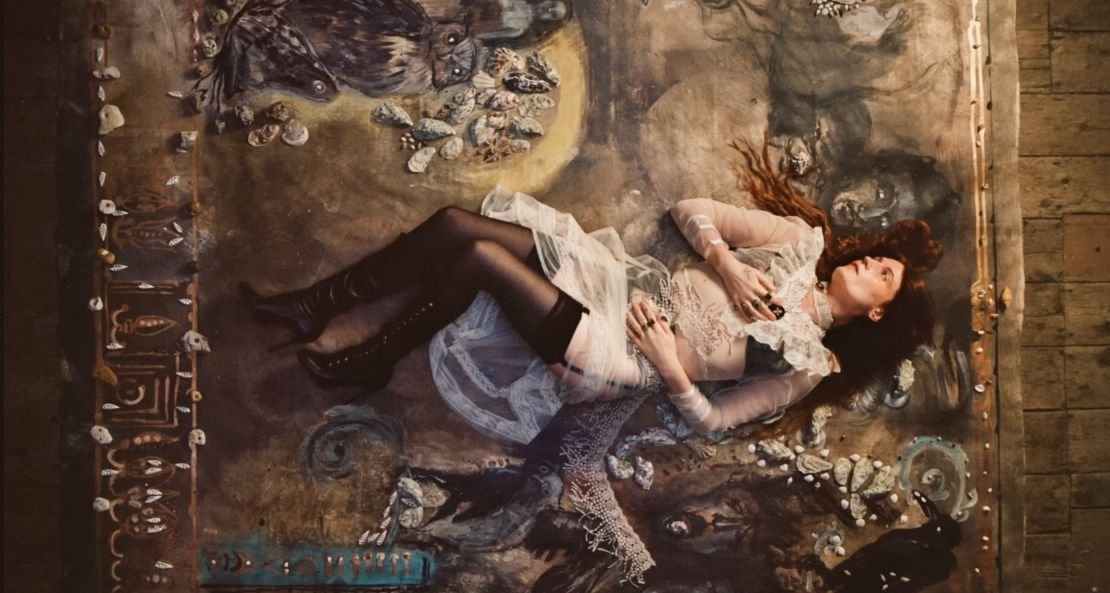
There’s a knowing weariness in Florence Welch’s voice as she addresses her return to music with Everybody Scream, her sixth studio album. Within its twelve tracks lies a hidden treasure whose latent power invites a deep reverence: “The Old Religion (Chamber Version).”
The Standard Version: Setting the Foundation
Before examining the chamber arrangement, we must understand the original. Track eight on Everybody Scream, “The Old Religion” was recorded at Aaron Dessner’s Long Pond Studio in New York’s Hudson Valley, a converted 18th-century barn where folklore meets modern production wizardry.
The setting itself, with its church-high ceilings and woodland views, seems almost too perfect for a song steeped in pagan mysticism and primal awakening.
The track opens with Welch describing an ancient force stirring within, an animal instinct reawakening. It builds intensity with primordial drumming and subtle synths in a way that feels deeply feral.
The production, courtesy of Dessner and Welch herself, strikes a balance between the orchestral drama that defines Florence + The Machine and something rawer, more immediate.
The Chamber Version: Stripping Back to the Sacred
The chamber version extends the original’s 3:40 runtime to 4:06, but those twenty-six additional seconds feel like stepping into a cathedral after wandering through a forest.
Where the standard version pulses with percussion and electronic textures, the chamber arrangement breathes differently. Organs swell where drums once pounded, strings caress where synthesizers once hummed.
What the chamber version of “The Old Religion” reveals is not just a sonic tweak, but a full re-contextualisation of the song’s primal instinct. In doing so, the central confession of exhaustion gains new resonance.
When Welch describes being wound so tightly she can hardly breathe, the chamber arrangement strips away the urgency, replacing it with ceremonial weight.
The result transforms Florence + The Machine’s “The Old Religion (Chamber Version)” from a sprint toward catharsis into something more ritualistic, more permanent.
What emerges is something both more intimate and more monumental. The pacing shifts from urgent to processional, transforming the song from a sprint toward release into a meditation on the hunger for it.
The organ, in particular, adds weight that the original couldn’t achieve. Each note carries the gravitas of centuries, of actual old religion rather than metaphorical yearning.
This is where Welch’s voice truly reveals its power. Without the shield of heavy production, every tremor, every controlled breath becomes audible.
When she confesses to being “wound so tightly, I hardly even breathe,” you believe it. You feel the constriction in your own chest.
Lyrical Architecture: Freedom Through Surrender
Early reviews of the standard version of “The Old Religion” described it as having folk-horror overtones with talk of animal instinct, bolts of lightning and scratching at Heaven’s door.
But those descriptions don’t capture what Florence + The Machine’s “The Old Religion (Chamber Version)” unpacks.
The chamber arrangement reveals that the song becomes less about wild release and more about ritualised surrender. The difference matters enormously.
The song’s narrative operates on multiple planes. On the surface, it’s about the resurgence of instinct, that old religion humming through veins, ancient and undeniable. But beneath lies something more personal and more universal: the exhaustion of constant control.
“So tired of being careful, so tired of being still / Give me something I can crush, something I can kill.” These lines cut to the bone.
Welch channels feminine rage as she demands release from the endless performance of propriety. It’s the scream before the scream, the moment when politeness fractures.
By returning to the old religion motif throughout the track, Welch invites us to explore what freedom can mean when you no longer fight for control.
This lyrical architecture in “The Old Religion (Chamber Version)” makes us reassess our instinct to perform rather than simply be.
The chamber version’s slower pacing allows each word to land with full force, transforming The Old Religion lyrics meaning from abstract spiritual yearning into visceral, bodily truth.
The chorus presents a paradox: fear and acceptance braided together. Lightning strikes and fallen trees, natural disasters that can’t be outrun.
The acknowledgment of powerlessness becomes its own strange comfort. You can’t escape yourself, so why keep running?
The second verse introduces meta-awareness that feels distinctly contemporary, with Welch acknowledging her role as a recurring dramatic protagonist.
She’s both mocking and embracing the archetype, admitting that she finds meaning in darkness, preferring life’s most challenging moments.
The image of scratching at heaven’s door on hands and knees is devastating in its vulnerability. This isn’t the triumphant Florence of “Dog Days Are Over.” This is someone genuinely grappling with mortality and meaning in the aftermath of trauma.
“The Old Religion” sits at the album’s midpoint, track eight of twelve, functioning as a turning point. On the album Everybody Scream, the chamber version of “The Old Religion” occupies this pivot point deliberately.
The album treads through womanhood, partnership, ageing, and dying, exposing the murky within the mundane.
After the manic energy of “Witch Dance” and “Sympathy Magic,” this track offers a moment of reckoning before the descent continues.
For Florence Welch, Florence + The Machine’s “The Old Religion (Chamber Version)” marks more than a remix or bonus track.
It’s a ritual entry into what the old religion means to her now, in 2025, after everything that has changed.
The chamber arrangement becomes the sonic embodiment of that shift from running to standing still, from resisting to receiving.
Every Florence + The Machine album contains these hidden depths, songs that work on you slowly, rewarding repeated listening with new revelations.
High as Hope gave us “The End of Love,” a dreamy New York-set meditation. Dance Fever offered “The Bomb,” a quiet contemplation amid chaos.
“The Old Religion (Chamber Version)” joins this lineage of tracks that operate outside the singles-and-spectacle machinery, offering instead a space for genuine emotional archaeology.
The Temple Within
Florence Welch possesses a gift for making the personal feel mythological and the mythological feel painfully personal.
“The Old Religion (Chamber Version)” achieves both simultaneously. It’s a song about ancient forces and immediate wounds, about the space where they intersect and become indistinguishable.
The chamber arrangement reveals what was always present in the original but couldn’t quite break through the layers of production: a hymn for disappearing consciousness, a prayer for those who feel themselves unraveling. It’s music for deep souls intertwined infinitely, frozen in time by forces beyond control.
Florence Welch remains one of contemporary music’s most vital voices not despite her willingness to dwell in darkness but because of it.
“The Old Religion (Chamber Version)” stands as proof that elegance, touching beauty, and haunting depth can coexist in service of something genuinely meaningful.
Both versions offer their own truth, but the chamber arrangement invites you deeper into the temple, and once inside, you may find it difficult to leave.
Everybody Scream (Chamber Version) is available now via Polydor Records and Republic Records. The deluxe edition includes chamber versions of four tracks, adding depth to an already substantial work. Florence + The Machine’s North American tour begins April 8, 2025 in Minneapolis.