
Jack Harlow’s “Lovin On Me” is a two-minute rap-pop track built around a hook about not wanting to be tied down, from a rapper whose appeal has always been disarming first, explaining itself later. The meaning sits on the surface. The interest is in how deliberately it stays there.
The production story starts in June 2023 when Florida-born beatmaker Sean Momberger found a 1995 Detroit R&B record by Cadillac Dale, born Delbert Greer, titled Whatever (Bass Soliloquy).
The central line: I don’t like no whips and chains, and you can’t tie me down. Momberger chopped the vocal, looped it, pushed the tempo up, stripped the original bass and replaced it with something cleaner, then dropped the session in a shared folder.
Ozan Yildirim (Oz) and Nik Frascona (Nik D) added drums and an 808 and pushed the tempo further.
That jump from Momberger’s R&B foundation to something genuinely up-tempo is where the track found its character. When Harlow received it, his engineer Nickie Jon Pabón said he responded immediately and told them not to send it to anyone else.
Cadillac Dale’s original had been a regional Detroit record at best. The sample feels familiar because of the era it pulls from, not because anyone knows the original. When Dale found out his vocal was at the centre of a global number one, he and Harlow met at a Detroit Lions Thanksgiving game.
I’m vanilla, baby / I’ll choke you, but I ain’t no killer, baby. That is the entire argument of the song in two lines. Harlow is naming himself uncool, safe, non-threatening, a white rapper who knows exactly how the culture reads him, and turning it into its own kind of swagger.
The “vanilla” self-description is not a concession. It is him planting a flag.
The “whips and chains” hook is a double entendre built around BDSM imagery that lands on the side of old-school romance rather than transgression: no complications, just affection. He is not claiming hard. He is claiming his own version of control within a mode of rap that does not require the usual signifiers to prove it.
The first verse builds from there. Young J-A-C-K, AKA Rico like Suave, Young Enrique borrows the energy of 1990s Latin lover archetypes without claiming their heritage.
She wearin’ cheetah print, that’s how bad she wanna be spotted ’round your boy is doing more than it looks like.
The spotted animal print is about wanting to be seen near him specifically, not just seen. It is a line about reflected status dressed up as a fashion observation.
In the second verse, Young M-I-S-S-I-O-N-A-R-Y spells out his TikTok handle mid-bar, which sounds absurd on paper and works in practice because it is so nakedly self-aware. The Lord Farquaad bar is the one most critics glossed over.
Farquaad is not a cool villain. He is petty, arrogant, known for disposing of people he no longer needs, and notably short in stature.
Harlow is not reaching for conventional rap masculinity here. He is saying: I archive people, I keep it brief, and I find that funny. The cartoon reference lands because the self-deprecation is intentional, which gives it more edge than a straightforward flex would.
The outro drops the lyrical pretence entirely and becomes crowd choreography, segmenting the room by gender, giving instructions, addressing the men waiting for the next track, turning the final third of a two-minute song into something built for the room. The verses are for listeners who pay attention. The hook and the outro are for everyone else.

“Lovin On Me” was released on November 10, 2023, through Atlantic Records. It debuted on the Billboard Hot 100 at number two before knocking Taylor Swift’s “Cruel Summer” off the top spot in its second week, and hit number one in the UK the week after release.
What made the chart run notable was that the song grew rather than front-loaded. By its second week, Harlow’s airplay audience had grown by over 70 percent, a pattern closer to how pop hits build than how most rap hits behave right now.
The music video, directed by Aidan Cullen and released the same day as the single, does not try to add anything the song does not already say.
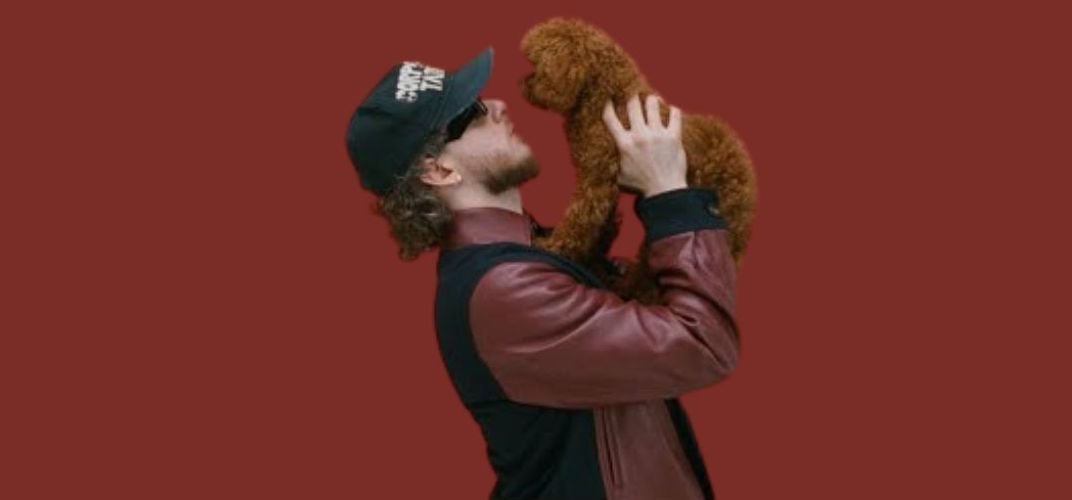
Harlow in a mullet and New Balance joggers, performing in various settings with friends, with the same puppy from the TikTok teaser making a return. No overly planned concept. It is an extension of the persona rather than a statement about it.
The first 36 weeks of 2023 produced no rap number one on the Hot 100, the genre’s longest absence from the summit since the early 2000s.
“Lovin On Me” broke into that space not by being harder or more genre-pure but by being immediately accessible without sacrificing craft, the same move Doja Cat made with “Paint the Town Red” that same year, letting a sample carry the melody while the rapper’s personality drove the verses. In a pop-dominant chart environment, that approach travels faster than technical display.
Harlow’s previous number ones, “First Class” sampling Fergie’s “Glamorous” and the Lil Nas X collaboration “Industry Baby,” had followed adjacent paths, but “Lovin On Me” is the most complete version of the approach.
The sample and the writing are in actual conversation. He builds his hook directly from the Cadillac Dale vocal, his verses play against the frame the sample establishes, and the whole track holds together rather than sitting as a rap vocal dropped on top of borrowed heat.
What the song is not is a lyrical showcase. Compared to “What’s Poppin,” his 2020 breakthrough which ran harder on bars, “Lovin On Me” is more interested in feel than craft. It runs just over two minutes, and is completely comfortable being liked. Most rap records at least pretend to be more than that. “Lovin On Me” never does, and that is exactly why it worked.
You might also like: