

The United States still exports more music than any other country, but here’s what the industry won’t tell you: American artists make more money in Canada than they do at home.
The UK sits in second place, yet Ireland imports their music more eagerly than their own domestic market does.
Brazil just overtook Sweden in global export power, and the entire streaming industry is pretending this is about algorithms when it’s really about which languages the gatekeepers are finally willing to learn.
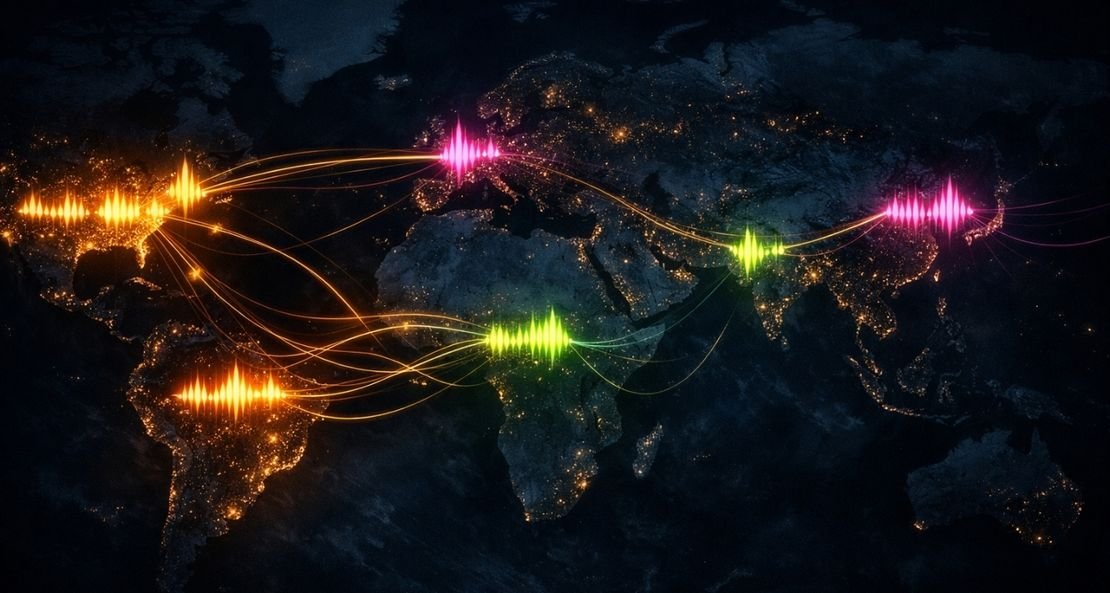
Luminate’s Q1 2025 Export Power Rankings aren’t just numbers. They’re a map of who gets heard, where money flows, and which borders still matter when everyone claims the internet made geography irrelevant.
For artists trying to build sustainable careers, understanding these patterns means the difference between chasing the wrong audience and finding the people who’ll actually pay attention.
Quick Answers: Global Music Export & Market Leaders
Which country is the biggest exporter of music?
The United States ranks first in global music export power, with Canada, Australia, and the United Kingdom as its largest importers.
Which country is leading in the music industry?
The United States leads with $17.1 billion in recorded music revenue (2024), followed by Japan, the United Kingdom, Germany, and China as the top five markets by total revenue.
What country sells the most music?
The United States generates the most music sales revenue globally at $17.1 billion annually, though its growth rate (4.6%) lags behind emerging markets like the Middle East & North Africa (22.8% growth).
Is shipping to Puerto Rico an export?
No. Puerto Rico is a US territory, so shipping there is domestic commerce. However, Luminate tracks Puerto Rico separately in export power rankings because its music industry operates with distinct cultural identity and export patterns that differ from mainland US markets.
The Export Power League Table
Top 10 by Global Music Export Power (Q1 2025):
- United States – Biggest importers: Canada, Australia, United Kingdom
- United Kingdom – Biggest importers: United States, Ireland, Australia
- Canada – Biggest importers: United States, United Kingdom, Australia
- South Korea – Biggest importers: Japan, Taiwan, Indonesia
- Germany
- France
- Puerto Rico (US territory, tracked separately due to distinct music industry)
- Australia
- Brazil (up from 10th, overtaking Sweden)
- Sweden (down from 9th)
Key Statistics:
- Fastest-growing music regions: Middle East & North Africa (+22.8%), Sub-Saharan Africa (+22.6%), Latin America (+22.5%)
- Largest music market by revenue: United States ($17.1 billion annually)
- Global streaming growth: 10.3% in H1 2025
- US streaming growth: 4.6% (slowest among major markets)
- Rest of world streaming growth: 12.6% (excluding US)
- Notable movers: Brazil jumped from 10th to 9th, Nigeria rose from 23rd to 19th
The top three countries share a language, but more importantly, they share infrastructure.
Spotify’s Stockholm headquarters didn’t stop Sweden from sliding down the rankings.
Canada’s position at number three isn’t about Drake anymore; it’s about decades of industry relationships that treat the US-Canada border as a suggestion rather than a barrier.
Puerto Rico appears at seventh despite being a US territory because Luminate tracks it separately.
The Puerto Rican music industry operates with enough cultural and commercial independence that its export patterns look nothing like mainland America’s.
Bad Bunny doesn’t export the same way Taylor Swift does, even though they’re technically from the same country.
What Export Power Actually Measures
Luminate’s Export Power Score calculates a country’s ability to export music globally using four metrics:
- Artist streaming rankings – How artists rank by total on-demand streams based on their country of origin
- Import country reach – The number of countries importing music from the export country
- Import market size – The streaming market size of countries importing the music
- Artist volume – The number of artists from each export country reaching international audiences
Export power measures influence, not just revenue. A country scores high when it has significant volume of artists reaching international markets, with strong performance in those countries, particularly in markets that represent a larger share of the global music industry.
Brazil’s jump from tenth to ninth tells a different story. Latin music didn’t suddenly improve in quality.
The rest of the world finally built the distribution channels to handle it. Henrique & Juliano pulled 1.58 billion global streams in Q1 2025. That’s not a breakthrough; that’s infrastructure catching up to demand that existed for years.
The Geographic Trap Most Artists Fall Into

Here’s the pattern buried in the data: every artist in the top ten exporting countries has their biggest import market in an English-speaking nation or a direct neighbour.
South Korean artists dominate Japan, Taiwan, and Indonesia but barely register in the US top 100. K-pop’s physical album sales create the illusion of American success while streaming numbers expose the limits.
If you’re an artist from the UK, your audience in Ireland will stream you more than your audience in London.
If you’re American, Canadians will pay more attention than your fellow Americans.
The data suggests that perceived cultural proximity matters more than actual geographic distance.
Australian artists find audiences in the US and UK before they conquer their own region.
This creates a marketing problem most artists solve backwards. They target their home country first, then attempt to “break” international markets.
The export rankings suggest the opposite approach works better: find the foreign market most culturally aligned with your sound, build there, then leverage that success back home.
The Emerging Markets Everyone’s Misreading
The Philippines, Argentina, and Norway appeared in multiple countries’ top three importer lists for the first time in 2025.
The industry narrative frames this as “new opportunities,” but that’s backwards.
These countries were listening the entire time. What changed is that streaming services finally care about markets outside the G7.
Regional growth figures from IFPI’s Global Music Report 2025 reveal where the actual expansion is happening:
Global Music Market Growth by Region (2024-2025):
- Middle East & North Africa: +22.8% (streaming accounts for 99.5% of revenue)
- Sub-Saharan Africa: +22.6% (crossed $110 million for first time)
- Latin America: +22.5% (15th consecutive year of growth)
- United States: +4.6% (slowest growth among major markets)
- Global average excluding US: +12.6%
Top 5 Music Markets by Total Revenue:
- United States: $17.1 billion
- Japan: Remains in top 2 historically
- United Kingdom: Nearly 10% of global consumption
- Germany: Strong physical and streaming mix
- China: Rapid growth via Tencent Music, QQ Music, NetEase Cloud Music
The distinction matters: export power measures influence across borders, while market size measures domestic consumption and total revenue.
The US leads in both, but its export dominance is stronger than its revenue growth. Japan ranks second by revenue but doesn’t crack the top 10 for export power because Japanese music rarely travels beyond Asia.
The US music market grew by less than 5% while the Middle East and Africa more than doubled that rate.
For artists, this means the American market isn’t where growth lives anymore. It’s where legacy revenue goes to die slowly.
Why Brazil Matters More Than the Rankings Suggest
Brazil overtaking Sweden isn’t just about sertanejo and funk carioca finally getting algorithmic respect.
It exposes how the streaming economy rewards local audience density over international reach.
Sweden built its export power on a handful of pop writers and producers who functioned as sonic mercenaries for American and British artists.
That model worked until everyone else built their own production infrastructure.
Brazil’s domestic market is 75.2% local music, the highest rate in Latin America. Artists like Alok export internationally, but the growth comes from Brazilians streaming other Brazilians.
The export power ranking rewards this because large domestic streaming markets subsidise international expansion. You can’t tour globally if you’re broke from neglecting your home base.
The K-pop Plateau Nobody Wants to Admit
South Korea ranks fourth in export power, highest among non-English-speaking countries.
Rose topped South Korea’s artist exports in H1 2025, largely because “APT.” went viral. But here’s what the victory lap ignores: K-pop failed to place a single artist in the US top ten by streaming volume.
BTS used to appear in Luminate’s global streaming reports. Their absence in 2025 doesn’t mean they got worse. It means the Western market got bored.
Physical album sales still prop up K-pop’s export numbers. Seventeen sold nearly 3 million copies globally in H1 2025, but only 79,000 of those were in the US.
Le Sserafim became the only girl group to crack the US top ten CD albums with 73,000 copies.
These numbers sound impressive until you remember the US market moved on from physical sales a decade ago.
K-pop’s strength remains in Asia. Japan featured nine South Korean artists in its top fifty. Taiwan had four Korean acts in its top ten. Indonesia included three.
The lesson for non-K-pop artists: regional dominance beats global recognition every time. Better to own Japan than rent America.
What This Means for Your Marketing Strategy
The export power rankings reveal that language matters less than you think and cultural adjacency matters more.
Puerto Rico ranks seventh globally because Bad Bunny and his peers figured out how to make reggaeton feel essential rather than exotic.
They didn’t translate their music into English. They made English-speaking markets learn Spanish.
If you’re targeting international growth, study the import patterns. UK artists should prioritise Ireland and Australia before attempting to crack Germany.
American artists should treat Canada as their primary market and the US as secondary.
Artists from emerging markets should identify which established markets already import music from their region, then double down there before bothering with the US or UK.
The data also exposes the superfan economy. Global streaming grew 10.3% in H1 2025, but that growth is uneven.
Markets where streaming accounts for 99.5% of revenue (Middle East, North Africa) have no alternative monetisation.
Artists can’t tour there profitably yet. Compare that to markets where physical sales and live music still generate income alongside streaming.
Choose your growth market based on how many revenue streams it supports, not just streaming numbers and social media metrics.
The Infrastructure Question Nobody Answers

Here’s what the export power rankings don’t measure: which countries have the industry infrastructure to support international success.
The US, UK, and Canada dominate partially because they have booking agents, PR firms, playlist curators, and sync licensing networks that everyone else is still building.
Brazil’s rise comes with caveats. Latin artists can now export globally, but they’re still booking through American or European agencies to tour those markets.
Nigeria ranks nineteenth in export power but doesn’t have a single major booking agency that international venues recognise. The music travels; the money flow doesn’t follow.
For artists, this means export power rankings show where your music can reach, not where you can build a career.
If you’re from Brazil, you can get streams in Portugal and Angola. Whether you can tour those markets profitably depends on infrastructure the rankings ignore.
You might also like:
- The Evolution of the Music Streaming Industry
- Streaming Payouts 2025: Which Platform Pays Artists the Most?
- The 2024 Music Industry Trends Guide: What’s Really Changing and Why You Should Care
- Beyond The Music: Women In Leadership And Innovation
- Neo-Soul Renaissance: Must Listen Artists of 2023 and the Evolution of a Genre
- The Best Movie & TV Songs: Neon Music’s Picks That Made the Scenes Hit Harder
The Streaming Platform Bias
Every country in the top ten has strong representation on Spotify and Apple Music.
These platforms weight the export power score because they dominate global streaming.
But China’s music market barely registers in these rankings because Tencent Music, QQ Music, and NetEase Cloud Music don’t feed data into Western analytics firms the same way.
This creates a distortion: artists who succeed on Chinese platforms generate revenue but receive no credit in export power calculations.
The same applies to regional platforms across Africa and Southeast Asia. The rankings measure Western-legible success, not actual global reach.
Artists need to ask themselves: are you chasing chart positions that matter to your career, or chart positions that matter to industry gatekeepers who’ll never support you anyway?
If your sound aligns with markets using non-Western platforms, the export power rankings become irrelevant.
Where Language Actually Creates Barriers
English dominates the top three exporting countries, but Spanish proves you don’t need Anglo validation for global success.
Puerto Rico’s seventh-place ranking (tracked separately despite being a US territory) and Brazil at ninth demonstrate that language stops being a barrier once you reach critical mass.
The threshold appears to be around 200 million native speakers with internet access and disposable income.
Portuguese has that. Korean has that. Arabic has that. Most European languages don’t.
Swedish artists dominated for years by writing in English and letting Americans claim credit. That model collapsed once other countries built their own export infrastructure.
The implication: if your language has scale, lean into it. If it doesn’t, you’re not “crossing over” by singing in English; you’re just making it easier for English-speaking markets to ignore your cultural specificity while stealing your sound. Genre identity matters more than linguistic conformity.
The Festival Circuit Still Decides Who Travels
Export power correlates with festival infrastructure. The UK exports strongly because Glastonbury, Reading, and Latitude provide international showcases that lead to booking agent attention.
The US exports because SXSW, Coachella, and Lollapalooza function as industry showcases more than music festivals.
Brazil’s export growth follows the expansion of Rock in Rio and Lollapalooza Brazil as destinations that force international buyers to pay attention.
South Korea built export power by creating domestic festivals that Japanese and Taiwanese audiences travel to attend.
The music export comes second; the live event infrastructure comes first.
For emerging artists, this means recorded music export happens after you’ve built live audience elsewhere.
Don’t expect streams alone to create touring opportunities. The causality runs the other direction.
The Vinyl Revival’s Hidden Meaning
Physical sales increased 6.5% in the US during 2024-2025, driven entirely by vinyl’s 18th consecutive year of growth. CDs and DVDs dropped 6.1%.
This isn’t nostalgia. It’s audience segmentation. The listeners who buy vinyl are the listeners who attend concerts, buy merchandise, and actually pay for music.
Export power rankings don’t distinguish between free-tier streaming and paid subscriptions, between casual listeners and superfans. But artists building careers need to.
Turkey might import your music via free YouTube streams that generate nothing, while Germany imports via paid Spotify subscriptions and vinyl purchases that fund your next album.
The smart export strategy identifies not where the most ears are, but where the most wallets are.
Sometimes that’s a smaller market with higher engagement rather than a massive market of passive listeners.
What Sweden’s Decline Actually Reveals
Sweden dropping from ninth to tenth represents more than Brazil’s rise. It exposes how much of Sweden’s export power depended on Swedish producers and songwriters working for foreign artists.
When Max Martin writes for The Weeknd, that doesn’t count as Swedish export under Luminate’s methodology because The Weeknd is Canadian.
This matters because it reveals the difference between artist export and industry export.
Sweden still exports music industry services even as Swedish artist exports decline.
For artists, the lesson is that being the talent is different from controlling the infrastructure.
You can export successfully as an artist or as an industry, but the revenue flows differently.
The Real Growth Is in Markets You’re Ignoring
Sub-Saharan Africa crossed $110 million in music revenue for the first time in 2025, growing 22.6%.
That’s a rounding error compared to the US market’s $17.1 billion, but it’s growing 500% faster.
Artists who establish presence in emerging markets now will own those markets in five years when they’re worth pursuing.
The industry focuses on where the money is today. Smart artists focus on where the money will be tomorrow.
Nigeria at nineteenth in export power represents more opportunity than Canada at third because Nigeria’s trajectory points up while Canada’s points sideways.
Every market currently outside the top twenty will be inside it within a decade.
The question is whether you’ll already have audience there when the industry infrastructure catches up, or whether you’ll be competing with artists who built loyalty years earlier.
Why Geography Still Matters After All

The streaming age promised borderless music consumption. The export power rankings prove that was always fantasy.
Music still travels along cultural and linguistic lines, just faster than before. American artists still succeed in Canada more than Colombia. UK artists still export to Australia more than Argentina.
What changed is that the borders became permeable rather than impenetrable. You can breach them now, but you still need to know they exist.
The artists succeeding internationally are the ones treating export as strategic rather than accidental, building audiences in adjacent markets before attempting distant ones.
The export power rankings hand you a map. Most artists ignore it and wonder why their music disappears outside their home country.
The successful ones study where their sound already has cultural infrastructure, then build there deliberately.
Stop trying to be universal. Be specific about where your music already makes sense to someone else, then make it make sense to more people in those places. That’s how you turn streams into careers.
Subscribe to Neon Music for more insights on how the music industry really works, delivered to your inbox every week.