
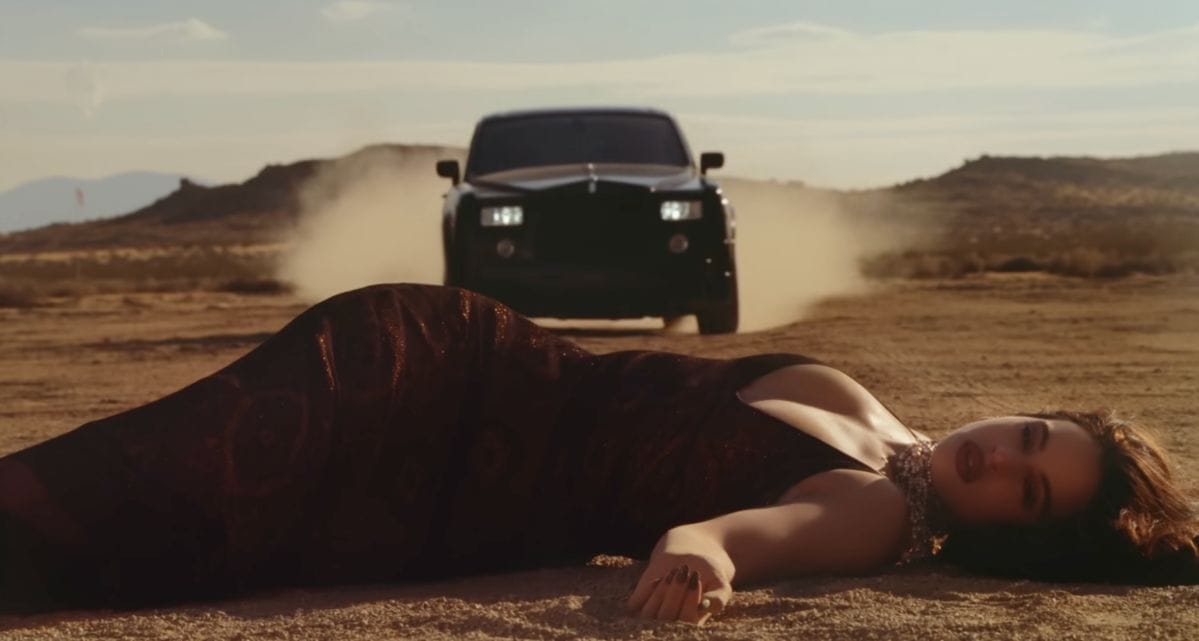
Face-down in desert sand, ROSALÍA doesn’t look up when the Rolls-Royce appears on the horizon.
It trails dust across the flatlands toward her, and she stays exactly where she is: not bracing, not watching, just down.
“Sauvignon Blanc” is a song about surrendering material wealth for love and spiritual clarity, with ROSALÍA declaring she’ll burn her Rolls-Royce to kindle light, throw away the Jimmy Choos, let the porcelain fall, give the piano away.
Track 13 on LUX (2025), it draws partly from Santa Teresa de Jesús, the 16th-century Spanish nun who renounced wealth and material objects in pursuit of spiritual purification.
The video, directed by Noah Dillon and shot in the Mojave desert, shows ROSALÍA prostrate on the ground as a Rolls-Royce arrives, lifted by an invisible force, and watching the car burn.
Dillon, who also shot the LUX album cover, built it around a simple brief: a quiet love story with an invisible partner.
The video cuts between two settings. Inside the car, she’s laughing in the back seat, pearls piled at her collarbone, filmed with a looseness that reads as genuine rather than staged, the intimacy of someone pointing a phone at a person they love.
That person is never shown. The song’s premise is founded on this absence: “Your love will be my capital,” she sings, and the video treats them as already gone, present only in the warmth of those interior shots before cutting back to the desert.
Outside, she’s prostrate on the ground, still in the same clothes, still wearing the pearls.
Dillon described this recurring image across the LUX visual world as a form of religious prostration. The wealth hasn’t been stripped from her. It followed her down.
When the Rolls finally pulls up and parks alongside her prone body, she still doesn’t acknowledge it.
What eventually lifts her isn’t the car’s arrival. It’s something else entirely, and the video is deliberate about withholding what that something is.
She floats horizontally above the sand, suspended, body held parallel to the ground she wouldn’t leave when the vehicle came.
Speaking to Crack Magazine, Dillon described it simply: “an invisible love carrying her across the landscape.”
Not divine intervention, not resolve. The absent partner, the one never shown in the car, is the force that moves her. The Rolls couldn’t.
Asked what the car represents symbolically, Dillon gave a single word: the journey. It sits there without elaboration. In the lyric, the Rolls is what she’ll burn to make light, wealth converted into flame.
In the video it arrives like a threat, becomes a witness, and eventually burns at night, fully engulfed, on open ground.
For the fire itself Dillon drew from several traditions at once: the burning bush, Pentecost, the purifying fire of Zoroastrianism.
“A new beginning through the ashes of understanding,” he said. The car doesn’t explode or collapse. It just burns, completely, in the dark, while the desert holds still around it.
“I wanted the visual to mirror the energy of the song,” Dillon said, “never outshining or dwindling next to the music.”
As a piano ballad that barely clears two minutes, “Sauvignon Blanc” is the quietest thing on LUX, and the video doesn’t try to be more than the song is.
For some that reads as a limitation. Given what Dillon was working toward, with restraint as a deliberate statement, prostration as devotion, and an invisible love as the only force that matters, the sparseness is the point, not the constraint.
You might also like: