I must have listened to it ten or twelve times before I clocked what was actually bothering me.
The version of Drag Path on Spotify opens with “You found me.” That’s the address to the torchbearer, the light, whoever comes to pull him back out. It drops you straight into relief. But that’s not where the song originally started.
On Breach: Digital Remains, the version only a limited number of people bought during that one-week window in September 2025, the first thing you heard was “He found me.”
The darkness. Blurryface. Whatever name it’s wearing this cycle. That verse is gone from the streaming edit entirely.
The band removed it, swapped the structure, and cut 1 minute and 20 seconds from the runtime. The version the world now hears skips the darkness arriving and opens with the response to it.
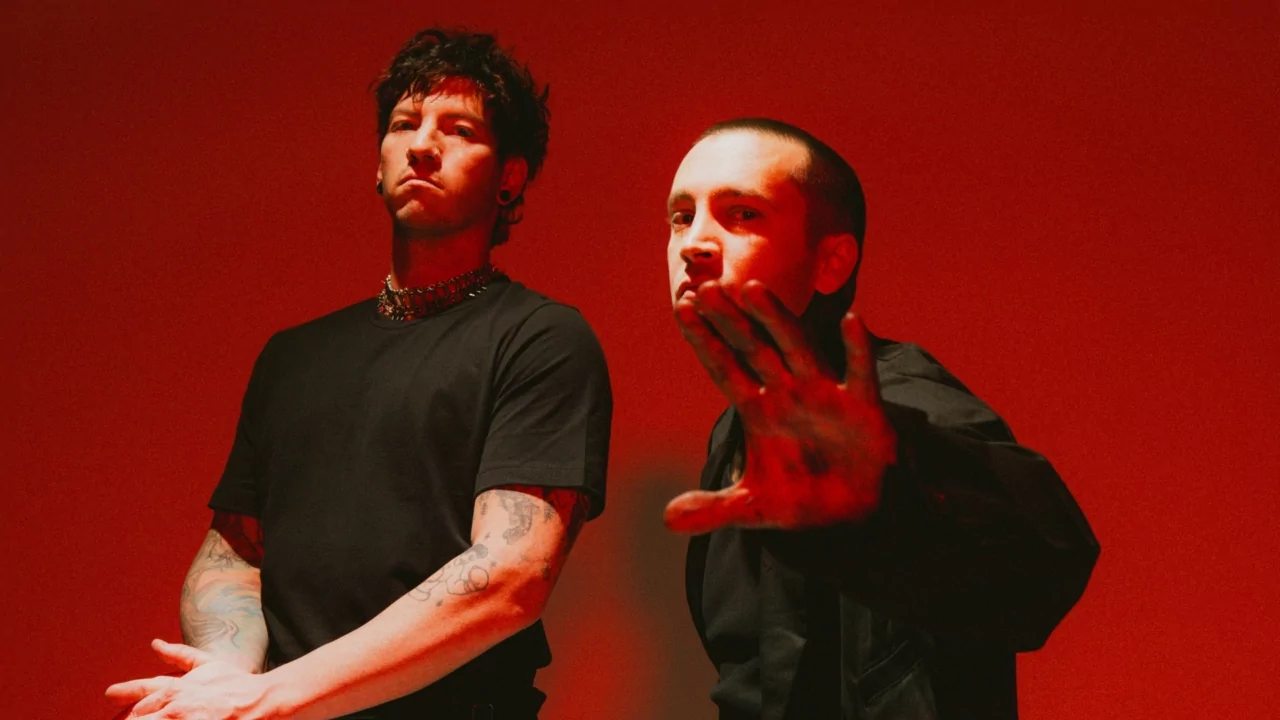
That’s not an accident. The edit is a statement. Tyler Joseph and Josh Dun deliberately released a version of Drag Path that begins in the middle of survival rather than at the moment of being found.
The people who bought the physical edition own the whole arc. Everyone else gets dropped into the chorus.
Drag Path is about leaving evidence of yourself for someone to find. Tyler Joseph writes about being dragged back into darkness and digging his heels into the ground on purpose, not to escape, but to leave a trail for whoever is coming to pull him out.
This matters more now that the song is officially out. On February 17, 2026, yesterday, Twenty One Pilots released Drag Path to all streaming platforms, alongside a music video that uses footage from a 2010 short film called Out of a Forest.
Tyler Joseph personally reached out to its director, Tobias Gundorff Boesen, to adapt the short. The version now on Spotify is slightly edited from the original.
The band went back into the studio to record a shorter take, out of respect for the people who bought the physical edition during the one-week window last September.
“What began as a song that belonged to a few grew into something meant for many,” they said.
Which is a nice way of describing a copyright black hole that accidentally produced one of the most emotionally resonant TikTok phenomena of 2025.
Let’s back up.
A Song That Wasn’t Supposed to Exist Everywhere
Drag Path landed as the secret closing track on Breach: Digital Remains, the limited-edition expansion of last year’s Breach album, available for exactly one week in September 2025.
No streaming. No YouTube upload. Physical purchase only. After that week, the plan was for it to disappear.
What actually happened was the opposite of disappearing. Because there was no official sound in TikTok’s catalogue, users uploaded raw audio themselves. Just rips passed around like tape dubs.
And the platform’s matching system had nothing to flag. The song moved freely. By November 2025, the most-watched edit using the track turned out to be a puffer fish video.
Then the grief montages started. By the time Atlantic Records and Fueled by Ramen thought to look, the song had accumulated 1.5 billion views across more than 75,000 TikTok creations.
The copyright vacuum that let the song spread also left it defenceless. There was no reference file to protect it.
So when a user named Alpha Moro uploaded Drag Path through a distributor and filed it as their own release, the automated systems (YouTube’s Content ID, TikTok’s audio matching) accepted it.
They don’t verify authorship. They verify paperwork. Whoever files first gets the keys.
Suddenly, content creators who’d built emotional tributes around the track had their videos muted by a total stranger with a submission form.
Atlantic Records had to chase the fraud down manually, while some straight audio rips of the song survived on YouTube for days, which tells you how inconsistent the label’s own monitoring was.
It’s one of the stranger recent examples of a label’s deliberate scarcity strategy backfiring in two directions at once.
It made the song a cultural event, and it also temporarily handed legal ownership to a random fraudster.
“They don’t verify authorship. They verify paperwork. Whoever files first gets the keys.”
The Pronouns, the Lore, and Why the Ending Already Happened
The Trench-to-Clancy lore has been dissected to within an inch of its life, but Drag Path sits in a specific place within it that most coverage has skipped over.
It’s the true ending of the cycle. Not a climax, not a fight scene, but the moment after Clancy loses again, and what he does with that.
The chorus describes being dragged back toward Dema. He digs his heels into the gravel, not to stop it (he can’t stop it) but to leave marks in the surface. Deliberately. The drag path isn’t a scar he’s ashamed of. It’s a signal he’s laying down on purpose. He’s not trying to escape. He’s trying to be found.
And this is where the pronoun shift becomes load-bearing. “He found me” in the verse is blurryface. The darkness that returns on schedule.
By the chorus, the same phrase flips direction entirely. “You found me” is Joseph talking to the torchbearer.
Josh Dun in biographical terms, God in theological ones, the support system that shows up whenever the darkness does.
The logic underneath this is almost classical. If blurryface is here, the torchbearer is close. The devil is evidence of the other side. Joseph has survived enough cycles that he can read their arrival as paired.
Clancy, as a character across this lore, functions as hope in human form. A new version of Tyler attempting to break the cycle after losing the previous round, becoming a bishop, beginning again.
Drag Path is that losing, held without despair. The person being pulled away doesn’t give up on being found. That’s not resignation. It’s the harder thing.
The final three lines, the sun rising, the darkest night ending, the confirmation of being found, are written in past tense. He already knows the outcome. He’s writing from the other side of the cycle, looking back at the drag path he left. Knowing he’ll leave one again.
The French Word Nobody Can Agree On
The Reddit thread about the lyrics got stuck on one word for weeks. “Proof is in the adversaire.” Half the commenters thought the ‘y’ of ‘adversary’ had simply been swallowed in the delivery. One person suggested ‘adverse air.’ Someone else thought it might be a worship song reference.
It’s French. Adversaire means adversary. And if you hold it theologically, it starts to make a strange kind of sense.
When Joseph sees the devil’s eyes in the verse, he looks away and smiles. Not because he’s unafraid, but because the devil’s presence confirms the other side exists.
If there is a devil, there has to be a God. If there is blurryface, the torchbearer is somewhere close.
Darkness as evidence of light. It’s a logic that runs almost directly parallel to Lamentations 3, a biblical text written from the floor of a pit that somehow arrives at mercy.
Joseph doesn’t cite scripture. He rebuilds the emotional argument from scratch and lands in the same place.
The French word also breaks the rhyme scheme in a way an English word wouldn’t quite. It’s slightly off. Slightly other. Which might be the point. The proof isn’t in the obvious place. It’s in the friction. It’s in the thing that doesn’t fit.
The Rabbit, the Hat, and the Wrong Kind of Belonging
Out of a Forest is a 2010 stop-motion short by Danish director Tobias Gundorff Boesen, and it’s adorable in the specific way things are adorable when they’re also quietly devastating.
Joseph saw it, reached out to Boesen directly, and they adapted it into the video released yesterday. It was a good call.
A rabbit moves through a dense forest, hunted. The animation is careful and deliberate, every frame weighted. There’s a shot where the rabbit’s ear twitches, just a small jittery movement in the stop-motion, before it bolts.
That twitch is where the fear lives. Not in the chase sequence. In the half-second before it knows which way to run.
What’s harder to shake is the gap. The rabbit is with others. It looks like it fits. It doesn’t. There’s a distance between it and the world around it that proximity doesn’t close. And then it’s pulled from a hat. Stage. Lights. Audience. Forest gone.
It reads as loss until you sit with it. The life being interrupted wasn’t the rabbit’s life. It was the life assigned to it.
The forest, the hunting, the instinct to hide and run. All of that belonged to someone else’s story. The hat is a rupture and a rescue at the same time.
Being different wasn’t resolved in the forest. It’s elevated on the stage. The thing that made the rabbit a target in one context makes it the centrepiece in another.
That reading maps onto the song’s theology closely enough that it can’t be accidental.
Clancy, dragged back to Dema, digging heels into gravel. A drag path that looks like failure and is actually a signal. Evidence left on purpose.
Why the Production Sounds Like Space
When you listen to this on headphones the first few times trying to pull it apart, and honestly, at first it felt unfinished. Clean guitar figure. A kick drum that’s barely doing anything.
Joseph singing low in his throat, in the register he uses when the material is personal. Nothing arriving to fill the space.
It wasn’t until the third or fourth listen that the space made sense. The production isn’t sparse because they ran out of ideas.
It’s sparse because the track was built to carry someone else’s footage. The 75,000 TikTok grief montages worked because the song doesn’t compete with what’s on screen. It holds. It gives the image room.
The emotional peak comes not from a wall of sound arriving in the final chorus but from the harmonic resolution in the bridge, when the harmonies open and the key shifts.
It sounds like a door opening from the other side. The sun begins to rise and the mix brightens in exact proportion. It’s small and precise and it lands harder than a build would.
The slightly shortened streaming edit, different from the Breach: Digital Remains original, doesn’t lose that.
Those who bought the physical version still have something the rest of us don’t, which was the point.
The band held the line on that even as they released it everywhere. It’s a small gesture and a deliberate one.
The song was never designed for headphones in isolation. It was built to carry someone else’s story.
In the last frame of Out of a Forest, the rabbit stands on a stage. Lights up. The audience is there. It’s not looking back at the forest.
Somewhere, a content creator’s grief montage is still muted, claimed by someone who filed paperwork faster than a record label could verify authorship.
And the drag path is still there in the gravel. It was always there. He left it on purpose.
But I keep thinking about that rabbit under the lights. When the audience leaves and the stage goes dark, does it miss the forest? Or did it never belong there at all?
You might also like:
- Twenty One Pilots “Downstairs” lyrics meaning: a cellar prayer with the lights off
- Twenty One Pilots “RAWFEAR” lyrics meaning: a sprint powered by nerves, memory, and a loop that won’t slow down
- The Contract Lyrics Breakdown: Twenty One Pilots Sign Their Name in Blood and Sleepless Nights
- Twenty One Pilots Backslide Lyrics: A Look into Duality, Regret, and Hope
- Navigating Nightfall: A Deep Dive into the Layers of “Routines in the Night” by Twenty One Pilots
- “The Line”: Twenty One Pilots Craft Viktor’s Story for Arcane Season 2