
Seven minutes and fifty-nine seconds. The runtime alone tells you Ren understands that control disguises itself as precision.
Vincent’s Tale – Starry Night operates at the exact threshold where patience becomes punishment, where a song transforms into an ordeal you can’t dismiss as background noise.
This isn’t the measured runtime of radio compromise. It’s the length required to watch someone discover unity consciousness only to have it surgically removed.
The track opens with Vincent in prison addressing an invisible tribunal. His first words: “How do I begin? Wait a minute, I know. Step one, I repent. Step two, let me go, no.” The sarcasm drips.
Ren’s delivery suggests someone who’s rehearsed this performance of remorse so many times the words have calcified into theatre.
Then Vincent pivots: “F*ck that, let me speak my mind.” What follows isn’t a defence. It’s a manifesto delivered from someone who’s already accepted they’ve lost.
Act I tears through systemic failure with surgical precision. “Homeless levels rise and the politicians pardoned / Slave labour wage docking pay for the farmers” lands not as revelation but catalogue.
Vincent isn’t discovering injustice, he’s itemising it. The stomping percussion Ren recorded himself creates a rhythm that feels less like music and more like marching, the kind of synchronised sound that powers riots and military drills equally.
When he raps “Nine-to-five, I can’t survive / I wake just to work in a job that can’t provide,” the line works because it refuses melodrama. This is stated fact, not complaint.
The production throughout Starry Night commits to organic sound with the fervour of someone who knows synthesised perfection is its own form of control.
Ren stacked his own stomps, claps, and beatboxing rather than reaching for a drum kit. The choice mirrors Vincent’s rejection of systemic solutions.
When the music itself refuses processed ease, when it remains deliberately raw and occasionally off-kilter, it becomes philosophical position rather than aesthetic decision.
Act II shifts the lens inward. “Yes, I am the malevolent, degenerate, delegate / Incarcerate the truth, keep it separate.” Vincent stops addressing external systems and starts examining his own construction.
The beatboxing here feels almost confrontational in its intimacy, a reminder that the human voice can create rhythm without requiring anything beyond breath and intention.
When he delivers “I guess I was fucked from the get-go / Wrong place, and wrong time, guess so / Wrong planet, wrong mind,” the resignation carries weight because it acknowledges what most protest songs refuse: sometimes the system doesn’t break you. You were incompatible from birth.
Then Act III arrives and everything fractures. The choir vocals that Ren’s used across multiple tracks return, but here they don’t comfort. They sound like witness testimony.
“There’s no democracy / Democracy ain’t corporate lobby free-for-all” builds into “We are divine, we lose potential when we gravitate to greed.”
The prison setting falls away. Vincent stands amid riot and flame speaking directly to camera about human unity, about how ” That means, the I, the me, myself is you, and so were we in one.” The music swells with something approaching transcendence.
This is where most political tracks would end. Vincent found his truth. He articulated the solution.
He spoke enlightenment into existence whilst fire consumed the institutional machinery around him.
Roll credits. Except Ren understands that enlightenment without institutional approval looks identical to madness.
Act IV doesn’t just end the song. It lobotomises it. Percy’s voice cuts through like a scalpel: “Vincent, dear boy / I can feel your frustration / But you’re in very safe hands here now.”
The patronising warmth, the medical terminology weaponised as comfort. “We’re making gentlemen from criminals / And that’s what you’ll be / With a brand new method that’s sort of trialled and tested.”
When Vincent resists, Percy remains unbothered. The procedure isn’t negotiable. Progress requires compliance, and if compliance requires erasing the parts of you that question progress itself, well. “If progress wants a price? Let it.”
That final line crystallises everything Starry Night articulates about power’s relationship to consciousness.
Progress, as defined by those administering it, demands you forfeit precisely the capacity for thought that might question whether this particular progress serves you at all.
Vincent’s crime wasn’t violence. It was clarity. He saw through the performance of democracy, articulated the shared humanity that systems require us to fragment, and proposed unity as solution. The institution’s response: corrective surgery.
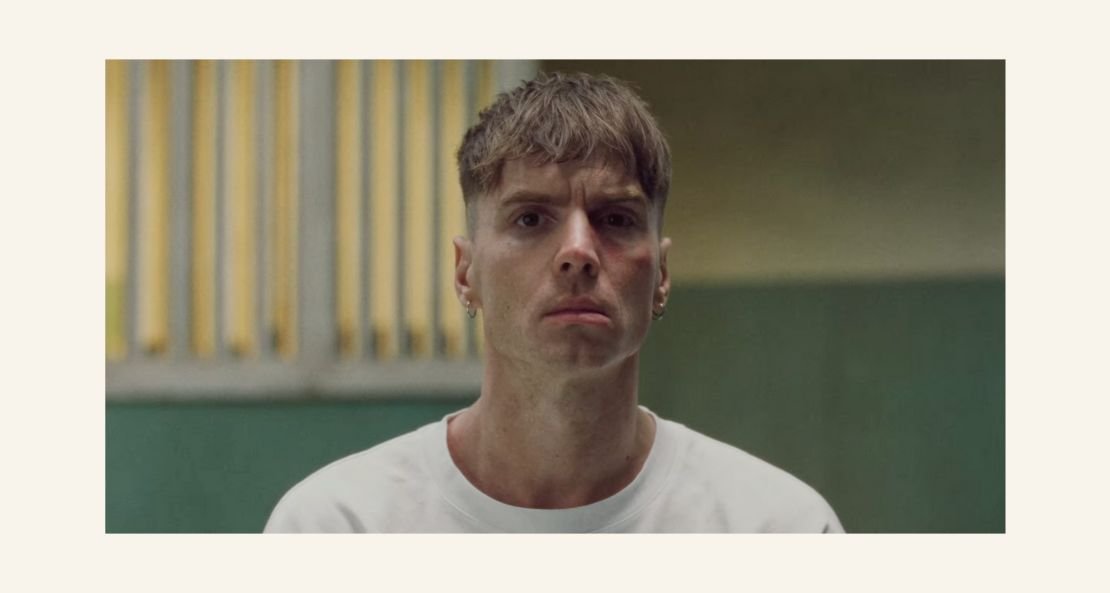
The video deepens this violence through accidental symbolism. Ren went temporarily blind during initial filming due to an autoimmune attack.
The black eye Vincent sports throughout wasn’t planned but integrated, the swollen tissue and streaming tears becoming character detail rather than production setback.
That Ren’s actual medical crisis merged with Vincent’s fictional one creates an uncomfortable recursion. The artist’s body breaking down whilst portraying systematic breakdown isn’t metaphor. It’s documentation.
The theatrical structure, divided into Acts and shot with Kubrickian framing, positions Starry Night as heir to a specific tradition.
Ren explicitly references Shakespeare, acknowledges the playwriting lineage he’s working within.
But where historical theatre used structure to impose order on chaos, here the formal divisions emphasise fragmentation. Each Act functions as discrete reality.
The shifts between them don’t flow, they rupture. We move from political rage to existential isolation to spiritual unity to medical violence without transition, without preparation.
This mirrors Vincent’s experience of coherence interrupted by institutional correction.
What makes Starry Night function beyond protest music’s typical limitations is its refusal to position Vincent as hero.
Ren describes him as anti-hero, possibly villain, someone whose actions in previous instalments earned his imprisonment. The track doesn’t argue for Vincent’s innocence. It argues for his consciousness.
The distinction matters. This isn’t about whether Vincent deserves freedom. It’s about whether anyone deserves their mind forcibly reconfigured because their thoughts threaten institutional stability.
The Van Gogh symbolism threading through operates less as artistic homage and more as historical parallel.
Vincent van Gogh, who created beauty whilst battling illness, whose work gained value only after his capacity to create it ended.
Vincent (the character), who articulates unity whilst imprisoned, whose mind becomes valuable only once it’s been restructured into compliance.
Both Vincents discovered something worth sharing. Both systems preferred them silent.
Ren released this in January 29, 2026, timing that positions Starry Night against recent political shifts that have rendered certain conversations about power increasingly difficult to have publicly without consequence.
The song arrives as governments worldwide escalate surveillance, as protest faces criminalisation, as the distance between dissent and diagnosis shrinks. Percy’s rehabilitation programme isn’t speculative fiction. It’s current events with a scalpel.
The final seconds linger on Percy’s voice: “This one will do. Yes, this one’s fine. Take him. Take him away.”
Vincent doesn’t resist anymore. The track doesn’t fade, it stops. No resolution, no hope, just the sound of someone being removed from the narrative they briefly controlled.
Most songs that tackle institutional violence end with the subject either triumphant or destroyed.
Starry Night chooses a third option: erased whilst still breathing, corrected into a version of himself that won’t cause problems anymore.
What stays isn’t Vincent’s enlightenment speech. That’s beautiful, certainly. “For there’s more to music / Life is music / Music is the tongue in the mouth of Mother Earth / And her heart beating is the drum.” It works.
But it’s the kind of truth that sounds good in isolation and achieves nothing when systems decide you’re insane for believing it.
What stays is Percy’s clinical enthusiasm for progress that requires lobotomy. What stays is the recognition that every system convinced of its own benevolence creates methods to correct those who disagree.
What stays is the question Starry Night poses but refuses to answer: if speaking truth makes you eligible for correction, when does silence become survival?
Neon Signals tracks where attention ignites and converts before songs break wide. If you want to catch the next resurgence while it’s still gathering momentum, you can subscribe here.
You might also like:
- Ren Self Portrait Lyrics Meaning: A Breakdown of Vincent’s Tale and the Chaos Within
- Ren Sunflowers Lyrics Meaning: A Cinematic Prologue to Vincent’s Tale
- Ren x The Skinner Brothers “Pink Heineken” Review
- Ren & The Skinner Brothers Dream Life Lyrics Meaning Explained
- Ren & The Skinner Brothers Twos On A Cigarette Review
- The Best Conscious Hip-Hop Songs of All Time: A Playlist for Social Change