
Right, let’s talk about what ROSALÍA’s just done. Three years after Motomami had everyone losing their minds, she’s released LUX, and honestly, it’s absolutely nothing like what anyone expected.
Where Motomami was sharp electronic edges and reggaeton heat, this is full orchestral grandeur.
Classical music through and through. The London Symphony Orchestra playing behind her. Religious imagery, songs across 13 languages, and depending on which credits you check, even 14 including Hebrew and Mandarin. It’s bold as hell.
The album opens with “Sexo, Violencia y Llantas” (Sex, Violence and Tyres) and immediately sets the tone.
Piano chords crash in, then she’s singing about wanting to exist between two worlds.
She declares she’ll love the world first, then turn to God. Takes you straight into her headspace.
Within a minute, she’s showcasing the full range of her voice, going from whisper-soft to absolutely soaring, and you realise this isn’t going to be background music.
What makes LUX genuinely fascinating is how it’s built around female saints and mystics from across history.
Figures like Saint Teresa of Ávila, Hildegard von Bingen, Joan of Arc, and women from traditions beyond Christianity inspired the tracks.
Each track draws from a different story, a different culture, and ROSALÍA spent an entire year learning how to pronounce and sing in languages she’d never touched before. Arabic, Japanese, Ukrainian, Latin, Italian, French, Sicilian, Portuguese.
The commitment is staggering. She’d write lyrics in Spanish, run them through translators, send them back 20 times until the phonetics and metre worked correctly. That level of dedication shows.
“Reliquia” (Relic) cuts deep. She’s cataloguing everything she’s lost whilst travelling the world: her faith in Washington DC, tears and fallen eyelashes in Japan.
But the chorus hits hard when she admits her heart was never truly hers because she always gives it away completely.
She sings about becoming a relic for her lover, something to keep when she’s not there.
The piano cuts through like glass whilst strings swell behind her. What she’s saying is raw, personal, immediate.
It’s about loving fully even when it destroys you, and the orchestral arrangement doesn’t let you look away from that pain.
Then “Mio Cristo” (My Christ) arrives and stops you in your tracks. Sung entirely in Italian, it’s ROSALÍA’s version of an opera aria, paying homage to both Maria Callas and Mina.
Her voice goes from massive, theatrical, operatic heights to intimate whispers, all controlled perfectly. When she sings “Mio Cristo piange diamante” (My Christ cries diamonds), every syllable lands with force.
The drama is overwhelming, and a flute in the background adds another layer. It feels like the final, glorious sunset over a city of ancient stone and forgotten romances.
“Porcelana” (Porcelain) is where things get wildly genre-fluid. She said on Zane Lowe, “The hook of ‘Porcelana,’ it was inspired in Amapiano but with a timpani and we had that very much written. It was just getting to the studio and being like, ‘This is the line, this is the melodic line we need,’ boom, we record it so, superquirúrgico.
It’s sung partly in Catalan with an orchestra building suspense. There’s flamenco palmas clapping and orchestral arrangements that shouldn’t work together but somehow do.
On paper it sounds chaotic. In practice, it’s brilliant. That’s the thing about ROSALÍA: she takes disparate elements and makes them feel inevitable. It builds throughout, keeping you on edge.
“La Perla” (The Pearl) deserves its own paragraph because it’s absolutely vicious. Features Yahritza y Su Esencia from música mexicana, and it’s basically ROSALÍA eviscerating an ex over a waltz.
The title has a double meaning: in Spanish slang, calling someone “una perla” means they’re a pain in the neck, someone to be careful with.
She delivers brutal lines about someone who’s won gold medals in being dishonest, someone who spends money they don’t have, someone who’ll never understand loyalty or faithfulness.
Then comes the killer blow about his masterpiece being his bra collection. Completely savage.
People reckon it’s about Rauw Alejandro, but whether it is or not doesn’t matter.
What matters is how she delivers total destruction whilst strings swell behind her. It’s the kind of breakup song that makes you want to applaud.
The multilingual approach isn’t just showing off. Each language connects to the saint or figure inspiring that track.
“Jeanne,” -available on the physical edition, is sung in French because it’s inspired by Joan of Arc. “Mio Cristo” uses Italian. “Dios Es Un Stalker“ (God Is A Stalker) toys with tango rhythms and has her positioning herself as God, tongue firmly in cheek.
She told France Inter the song contains humour because she wrote it from God’s perspective, which is absurd.
Piano, trumpets and timbals keep it perfectly dynamic. The humour cuts through the religious imagery, stopping things from getting too heavy or pretentious.
Here’s what’s brilliant about “Divinize”: she switches between Catalan and English whilst the orchestra gallops over timbals and violins like racing horses.
It’s a self-reassuring song where she sings about light being visible through her body, about bruising her and her eating her pride.
The orchestral backing is lush but never drowns her out. It’s an anthem about transformation, about letting yourself be seen even when it’s painful, about being made to divinise.
“De Madrugá” finally surfaces on LUX after fans begged for it during the El Mal Querer era. Originally written in 2018, the song was a tour staple but never had an official release.
Its long-awaited studio version is a complete rework, replacing the original Pharrell production with flamenco rhythms, Ukrainian lyrics, and lush strings.
The lyrics, about chains from the past and how no weapon can bring someone back, are deepened by the inspiration of Saint Olga of Kyiv.
ROSALÍA has explained that the saint’s violent story as a ruler who sent men to their death helped expand her idea of sainthood.
This new context transforms the track from a beloved relic into a key that unlocks the spiritual themes of LUX, making the wait worthwhile.
“La Yugular” (The Jugular) operates as a waltz-like ballad linking Andalusian expression with an Arab chorus.
The confusion between God and a loved one floats through the entire album, but it peaks here.
She asks how many stories fit in twenty-one grams, then sings about her chest containing someone, and her chest occupying their love, wanting to lose herself in that love.
When she sings about where they tie up horses, hers are well tied, the galloping onomatopoeia marks a highlight of LUX.
Closes with a voice memo from Patti Smith, which on paper sounds chaotic but fits perfectly within LUX’s world.
The album’s split into four movements, classical terminology that signals her intentions clearly.
It feels designed as a complete journey rather than individual tracks. “Mundo Nuevo” (New World) acts as an interlude, a copla reimagined as a saeta in an opera house, flamenco bursting from her chest.
She’s singing almost screaming from the desert that she’d love to inhabit a new world where more truth exists.
It’s the kind of track that originally got flamenco purists upset, but she doesn’t care.
“La Rumba del Perdón” (The Rumba of Forgiveness) is forgiveness as liberation rather than religious duty.
What could be read as a religious act becomes instead an act of freedom, turning forgiveness into a path to emotional lightness.
Features the Choir of Montserrat alongside Estrella Morente and Silvia Pérez Cruz, two of Spain’s greatest voices. Fiery flamenco vocals, dramatic violins, subtle guitars and palmas clapping ignite the track.
“Memória” (Memory) brings Carminho in for a fado-shaped reflection sung in Portuguese. It’s a contemplative moment that prepares you for the finale, closing this opera in a reflective tone.
“Magnolias” arrives as the finale. She’s imagining her own funeral, magnolias blooming over her casket. Sings about coming from the stars but turning to dust today to return to them.
The orchestral layers build gently, drums rolling, organ positioned perfectly. It’s meditative and moving. Leaves you sitting in silence when it ends, processing everything she’s put you through.
The bonus tracks exist for the physical editions (the album has 15 tracks digitally, 18 on CD and vinyl), though “Focu ‘Ranni” stands out.
Sung in Sicilian, it’s about working through rage and broken promises, alluding to a wedding that never happened. She declares she’ll just belong to herself and to her liberty. The emotion hits hard.
“Berghain“ deserves special mention as the lead single. Named after the German word for “mountain shelter” rather than the Berlin club, it features Björk and Yves Tumor.
The video shows ROSALÍA living a domestic life surrounded by an orchestra that barely fits in her living room.
Björk’s unmistakable voice and Yves Tumor’s punk-like edge combine with ROSALÍA’s operatic German and Spanish.
It’s one of the best songs she’s ever made, encapsulating everything LUX represents: rooted in Spanish tradition, open to global sounds, blending alternative textures with avant-garde songwriting.
What makes LUX genuinely special is how unapologetically challenging it is. There are no obvious singles here, no tracks designed to dominate TikTok or playlists.
ROSALÍA told the New York Times Popcast she wanted the opposite of dopamine-driven music, and she’s delivered exactly that.
This needs your full attention, your phone on silent, lights dimmed. It’s maximalist without being sterile, ambitious without losing emotion.
The woman spent time crying during recording sessions with the London Symphony Orchestra, feeling unprepared for such a massive undertaking.
Yet her mastery is staggering. Every arrangement was refined over months, hours at the piano perfecting each section. The heart is the main instrument throughout. Emotion guides everything, not perfection.
LUX operates as her fourth studio album after Los Ángeles (2017) brought centuries-old flamenco into the present, El Mal Querer (2018) combined Andalusian tradition with pop and hip-hop, and Motomami (2022) fused reggaeton with disruptive electronics.
Each album has shown her evolution, her willingness to completely reinvent herself rather than repeat what worked.
LUX feels like a degree in humanism after those earlier projects. It’s about being blessed rather than saintly, romantic rather than pious.
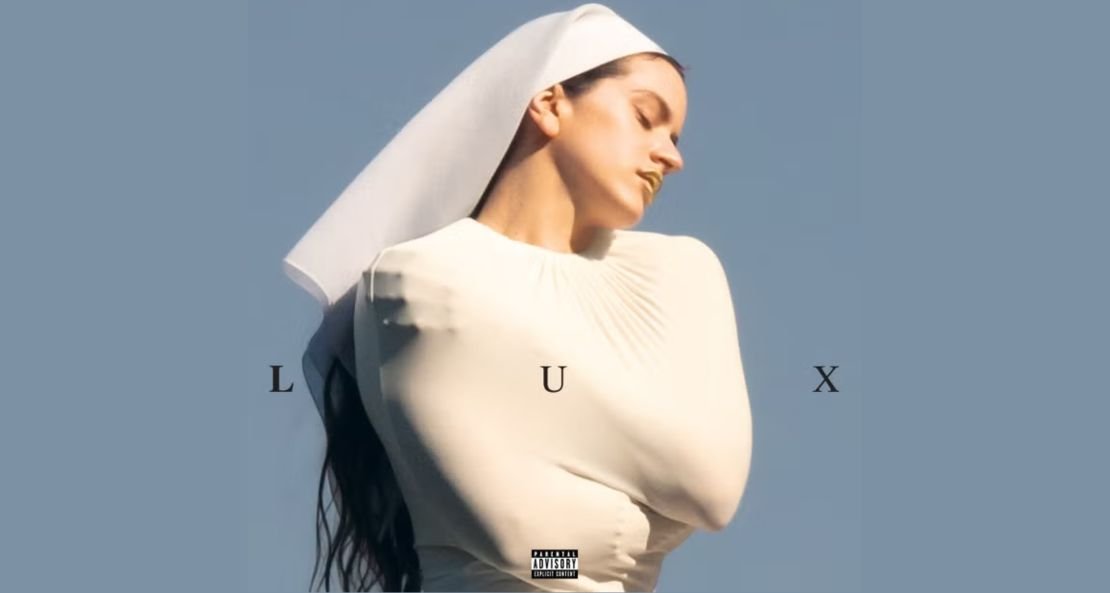
The religious imagery sits heavy throughout. ROSALÍA dressed as a nun on the cover (though sharp eyes noticed the straitjacket underneath), references to saints and mysticism everywhere, tracks named after religious concepts.
But she’s clear this isn’t about fitting religious codes. It’s about mysticism, about her personal journey, about exploring how faith and art merge.
She’s using Catholic iconography the way only a few Spanish musicians have dared: questioning cultural inheritance, playing with tradition, making something entirely her own.
You’ll want to listen to this multiple times. First time through, you’re overwhelmed by the sheer scale. Second time, you start catching details: the orchestral depth in “Porcelana,” the linguistic tension in “La Perla” where “una perla” means both pearl and pain in the neck, the galloping onomatopoeia in “La Yugular.”
Third time, you’re noticing how she bends rhythm and accent to create tension, making Spanish sound foreign, pushing language into new shapes.
Worth mentioning the artists who appear alongside ROSALÍA here. Beyond Björk and Yves Tumor on “Berghain,” you’ve got Carminho bringing fado expertise to “Memória,” Estrella Morente and Silvia Pérez Cruz lending their voices to “La Rumba del Perdón,”
Yahritza y Su Esencia adding música mexicana flavour to “La Perla.” Each voice fits perfectly within the song’s world, contributing to the overall vision.
The production throughout is meticulous. Daníel Bjarnason conducted the London Symphony Orchestra, with arrangements by Angélica Negrón, Caroline Shaw, and others. ROSALÍA served as executive producer, maintaining control over every element.
You can hear that attention to detail everywhere: the way strings swell at exactly the right moment, how percussion enters to shift the mood, when to pull back and let her voice carry the emotion alone.
“Sauvignon Blanc” is one of the album’s most transcendent tracks. It explores spiritual devotion whilst keeping nods to her American influences, occasional brand names appearing that might feel jarring but work metaphorically within the context.
ROSALÍA said about the track: If I sing in Spanish in ‘Sauvignon Blanc,’ it’s because there’s inspiration in Santa Teresa de Jesús and the fact that she decided to despojarse de todo lo material and apparently she came from money but she decided to get rid of all the material stuff and, you know, pursue another type of life and another path.
“Novia Robot” (Robot Girlfriend) centres on commentary about objectification and capitalism. It’s one of the album’s most contemporary pop-sounding tracks, featuring multiple languages and addressing how women are treated as commodities.
The album’s intensity never lets up. Even quieter moments carry heft. “Sexo, Violencia y Llantas” divides the world into earthly chaos (blood sports, coins on throats) versus magical mysticism (sparkles, pigeons, saints).
That tension between physical and spiritual, between loving the world and loving God, drives everything that follows. She’s not choosing one or the other. She’s trying to exist in both simultaneously.
LUX won’t be for everyone. If you loved Motomami’s sharp edges and dancefloor energy, this might initially disappoint.
If you came for “Despechá” vibes, you’ll be lost. ROSALÍA refuses to repeat herself, refuses to give audiences what they expect just because it’s safe.
She’s chasing something bigger here: creating art that challenges, that demands engagement, that actually gives something back when you put the time in.
Critics have been divided. Some classical music fans dismissed “Berghain” as kitsch immediately after release.
Others have called LUX an instant classic, a timeless work of art no other pop star could have made. ROSALÍA’s never been about purity in any genre.
She’s about feeling, about using whatever tools necessary to land emotional truth.
Spain’s relationship with ROSALÍA remains complicated. She’s either loved or loathed there, her use of religious imagery confronting a nation still uneasy about Catholic inheritance.
LUX makes her one of the bravest Spanish musicians questioning those cultural links, playing with tradition the way Lole y Manuel and Camarón dared decades ago. That takes real courage, especially when success would be easier by playing it safe.
How she’s ordered the tracks makes a difference. Starting with the piano drama of “Sexo, Violencia y Llantas,” moving through heartbreak and rage and mysticism, arriving at “Magnolias” imagining death as subjective concept rather than end. It’s a journey that requires commitment from listeners.
Put it on shuffle and you’ll miss how each movement builds on what came before, how themes develop across tracks, how her relationship with divinity and humanity evolves throughout.
ROSALÍA’s discussed how Leonard Cohen’s “Anthem” shaped LUX’s approach: “Ring the bells that still can ring, forget your perfect offering, there is a crack in everything, that’s how the light gets in.”
That philosophy runs through every track. She’s not chasing perfection. She’s chasing truth, emotion, connection. The cracks matter. The struggle matters. The darkness makes the light possible.
The multilingual ambition alone would be enough to make LUX remarkable. But it’s how she uses those languages that truly impresses.
She’s not just singing words. She’s inhabiting worlds, becoming vessels for these women’s stories, making centuries-old
tales feel immediate and personal. That takes immense skill and genuine respect for the source material.
Some tracks linger longer than others. “Divinize” and “Mio Cristo” feel like obvious highlights, moments where everything clicks perfectly. But deeper cuts deserve attention too.
“Dios Es Un Stalker” brings unexpected humour. “Mundo Nuevo” offers brief intensity. “La Yugular” builds slowly before that Patti Smith voice memo arrives. Like any hour-long album, not every moment hits with equal force, but each contributes to the overall journey.
Look at the cover again: ROSALÍA in white outfit resembling nun’s habit, eyes closed, lips gold, hugging herself with arms underneath the torso. Looks religious until you notice the straitjacket beneath.
That contradiction defines LUX entirely. Faith and restraint, freedom and imprisonment, divinity and humanity all existing simultaneously. She’s not resolving these tensions. She’s living inside them.
For fans who’ve followed ROSALÍA since Los Ángeles, LUX represents both logical progression and shocking departure.
The flamenco foundation remains, but everything built on top has transformed completely. She’s gone from studying centuries-old tradition to creating something that feels equally timeless.
Whether LUX will be remembered as classic remains to be seen, but the ambition alone marks it as significant.
Final word: LUX is audacious, occasionally difficult, frequently stunning. ROSALÍA’s made something that stands apart from everything else happening in pop music right now.
She’s risked alienating fans by refusing to repeat Motomami’s formula. She’s challenged herself vocally, linguistically, conceptually.
Whether you think it succeeds completely or stumbles occasionally, you can’t deny the sheer scale of what she’s attempted here.
This is an artist at the peak of her powers, unafraid to fail, unafraid to reach for something massive. The fact that she mostly pulls it off feels miraculous.